Sunday, 7 June 2015

Our History, In Pieces — Sprigging Luverly

Here's a nice desirable sherd of pottery and one that I had wanted to find for years before I finally did. It turned up in the most popular place for a family fossick on the entire Thames — at Bankside, and right outside Tate Modern. Quite how it had eluded others is beyond me, but there it was, half buried in the shingle and better, that patch yielded a number of other finds too. But that's how the Thames works. You don't wander off having found one thing. You stick at it right where the first find was made in the certain knowledge that you have discovered an area of fresh erosion that will continue to be productive until that erosion stops.


This is Roman 'terra sigillata' more commonly known as 'Samian ware', of course. A deep glossy brick red in colour, smooth and fine in texture and decorated with what's probably a legionary eagle. Surely there's no mistake about that. But hang on — what's that hole in the knob for?

Romans didn't drink tea... 

Not so far as we know, but the Chinese certainly did and when we British found out we built an Empire to rival Rome upon it.

The rise of the British Empire was fuelled by the stuff. It was the quintessential British beverage for three centuries and at the height of our power and influence late in the reign of Queen Victoria we consumed an astounding 6lb per person per year of dried leaf and fashioned teapots the size of pumpkins to brew it in.

As you can see, the teapot filled by the servant woman is rather small.
Hogarth's 'Apprehended by a Magistrate' from 'A Harlots Progress', 1732. 


Mercurius Politicus. September 1658
But in the beginning, our teapots were more the size of an orange than a pumpkin. And that's because tea was prohibitively expensive. It was more commonly available in coffee houses in the third quarter of the 1600's. The London newspaper, Mercurius Politicus, September 1658 announced,

'That Excellent, and by all Physicians approved, China Drink, called by the Chinese, Tcha, by other Nations Tay alias Tee', is sold at the Sultans Head, a Coffee house in Sweetings Rents by the Royal Exhange'.

At the time tax due was calculated from its liquid form. They'd brew up in the morning, the tax officer would quantify the duty to pay on the total pints made, it was kept on the boil all day long and dispensed in tiny cups for an appreciative public of gentlemen. But in 1689 the tax rules were changed. The leaf form was taxed instead (at about 25%) when it became available to anyone wanting to brew at home, but only to those very few who could afford to pay £10 per pound (equivalent to £1,000 per pound today!) and just as importantly, also secure the teapot in which to brew it.

Yixing teapot, 17th Century. Later repairs.
Probably the first ceramic teapots Joe Public clapped eyes on were those imported along with the initial tea consignment the East India Company brought back from Java in 1664. The shipment contained 100lb of tea worth at least £1,000 and perhaps more, but just £10 worth of these pots.

Alien objects made of a vitrified red clay the like of which had never been seen before and decorated with strange relief motifs that must have been quite a sensation to our eyes, they sold out immediately. Imports increased as tea drinking caught on but there were never quite enough pots to go round and demand was increasing exponentially so John Dwight of Fulham set to work to create copies. He never got beyond experiments and seems to have never sold a single pot, but a couple of Dutchmen did.

Elers Teapot, circa 1690
John Philip Elers and his brother David came to England, found a seam of the right kind of clay in Staffordshire, and created the first convincing British versions of the Chinese pots. But they ran into trouble with Dwight who tried to enforce his patent. Ignoring it they carried on regardless.

They sold but few. And not because the demand wasn't there. It was. Their failure was down to the fact that they were paranoid in the extreme about keeping their methods secret, each hand crafted pot was extremely time consuming to make and their products just too expensive for anyone but the most wealthy to purchase. The Elers brothers were declared bankrupt in 1700.

However, the Staffordshire 'potbanks' weren't to be defeated. By that time the tea trade was becoming less of a legitimate business and more of a criminal operation because taxation was spiralling out of control finally reaching an astonishing 119% by mid century. The gap between those who could afford this luxury and those who wanted to enjoy it was widening so far that, of course, smugglers stepped into the breach and supplied it tax free cutting prices (and cutting it with all kinds of other noxious stuff) to the bone. The huge demand had been finally met so the pots just had to be made somehow.

 The Elers had destroyed all evidence of their secrets and methods so initially the potbanks made lead-glazed earthenware versions. These were what we had till 1740 when finally they cracked it. Solving the clay supply problem by improving refining methods they made stoneware versions available at last and better still, threw the pots quickly on a wheel. The market was soon awash with handsome red teapots 'just like' the Chinese originals and cheap enough for the middling and perhaps even working classes, to own and enjoy.

Staffordshire redware 'crabstock handled' teapot, Circa 1760


The sherd under scrutiny is a piece of that history. It is the lid from a teapot and of course it's not a Roman one but a British one made in Staffordshire circa 1740-70. The decorations are known as 'sprigs'. They were formed in a mould, released onto paper, then applied to the damp body of the pot with a little brushed on slip. The dense fine clay is very strong but also takes sharp detail very well and that accounts for a great deal of the appeal. The bird is as crisp as the day it was made, and yet the lid is in a sorry state.

It may have been finally discarded only when the owner grew tired of trying to keep from falling into the pot because they were so treasured that people would use them till essential parts were unserviceable. Unless the pot itself was broken in many pieces and beyond water tight repair it would be kept and mended with new parts fashioned in wood, silver, tin, brass, pewter, and even poisonous lead.

The decorations soon departed from strict copying of Chinese motifs. By mid-century, at the height of Rococo style and our insatiable taste for 'chinoiserie', a delightfully eccentric mixture of sprigs in all kinds of diverse (and increasingly English) designs adorned them. My little teapot lid's bird sprig may look Chinese enough but it may have been accompanied by of all things, a Tudor rose! 


It's just a broken old teapot lid but I reckon I could flog it for £20 on Ebay given the current buoyant market for interesting sherds. I certainly couldn't afford to buy the parent pot in the one piece, though, because an ordinary one would set me back £500 and a rare and fancy one a thousand or two more.

Maybe instead I should list it as,  'Roman Samian Ware Teapot Lid — Legionary Eagle — RARE!'  

And would probably get £30 or perhaps more in succeeding to convince many that it really was...!

But knowing just half the truth behind this little piece of our history is better than peddling a half-thruth to others, so I'll keep it by. Enjoy it for what it is.

Because I think it's just sprigging luverly.


Monday, 1 June 2015

Pot Sherds — Our History, in Pieces

Visiting the Thames Foreshore recently has been quite a disappointment. I only ever practise eyes only searching there and in the forty years since I made my first find in the shingle I have never tried any other method. I rarely scrape, never dig, never detect with a machine. And I like it that way or at least I always have...

However, now I'm seriously considering other methods because the place is picked clean. Where years ago I'd go down and pick up thirty or forty items of non-ferrous metal, some of which would be nice finds, occasionally very nice indeed, now I can barely find two or three and only then by really pulling out all the stops and using all the knowledge acquired in my long mudlark career.

The reason is that nowadays mudlarking is a social event. Families do it, friends do it, every bloody bugger does it! Last time I was there I met a group of four young ladies out for a social fossick. Such a gaggle of hens would never have been seen years ago because the foreshore back then was a fearsome place where nobody in their right mind stayed for long. Nobody except people like me, that is. Those who enjoyed the brooding desolation, the frisson of danger, and the fact that the surface was littered with old stuff.

It still is. But I'm afraid it's littered with what old stuff nobody wants. Bricks and rubble and peg tiles, butchered bones and teeth. Those things that remain when all the nice stuff is gone. And by nice I don't mean hammered coins and pilgrims badges, I mean the sherds of pottery that once you could easily fill a carrier bag with are nowadays noticeable by their absence.

They have become a collectible in their own right. You can amass a collection from the Thames covering every period of British history from Neolithic to Modern if you know what to look for. Of course, the majority of sherds are going to be of relatively recent productions and will hail from the period of London's greatest might and power — the Post-Medieval period from 1550 onwards and into the modern era.  But it's all down there. And people know it.

The thing is, nowadays you cannot go and handle old pots without owning them yourself and that means paying a great deal of money for the privilege because even the most quotidian of 18th Century productions are going to cost well over £100 and the choice stuff, the Ralph Wood figures, the Bow porcelain, the salt glaze and the slipware platters are worth many hundreds and often many thousands. They are simply out of the reach of most people, unless that is they find bits of such desirable things on the foreshore, range them in a collector's cabinet. And they can do that because down there such a thing is possible to achieve, and for free.

Actually, there's something romantic about sherds of pots that complete pots do not possess. I know why people like them. They are small pieces of things hard to imagine in their completeness until you know what they are and have seen examples in the one piece. There's a mystery to solve meanwhile between finding one and finding its parent object through study and research. That's a very enjoyable process.

And it's one I want to write about here. So, I've decided to run an occasional series about pot sherds starting with a very interesting one that was missed by the new breed of collector I've encountered lately but was found by myself and in the most public and popular place on the entire foreshore — the South Bank right below Tate Modern.


Tuesday, 10 June 2014

Venus Victrix


It’s 1990 and I’m bored with my life, something is missing from it and for the life of me I cannot think what that crucial ‘something’ might be. We’re walking our dogs along the old track ways of Hainault Forest and wondering just how ancient they really were when my then partner, Rebecca, suggests I get a metal detector and find out… Three weeks later, I take delivery of a C-Scope 770d and my life is complete!

Early 1900's, publisher, Birn Bros of London, copyright lapsed
The forest was magical with its ancient pollard hornbeams, and was once the home of a famous hermit locally known as 'Old Dido' who lived under a tarpaulin but who left no trace behind for me to find. The woodland tracks proved to be Georgian at the earliest and though I made a few nice discoveries of coins and objects lost by canoodling Victorian lovers, I was soon finished with them.

I then had an amazing run of beginners luck on one small parcel of pasture digging what remain to this day some of the best finds I’ve ever made including a Bronze Age hoard, a gold noble and a Medieval gilt-bronze figure of St John the Evangelist. The gold coin was my first ‘hammered.’ That’s how jammy I was. But, all good things come to an end and it wasn’t long before I was short on finds and hungry for a new site.

One day out and about looking for pastures new I stumbled across a little cache of tiny child-sized thimbles in the grassy verge of a lakeside track. Investigating further I found a few buttons too, and then musket balls as well. Those finds proved to be the start of a passionate exploration of what turned out to be the most fascinating site — the long demolished remains of an early 19th Century gamekeeper’s cottage that existed for less than a century.

Copyright Jeff Hatt
Every find was a personal one. The husband’s military buttons of which I found three from the same tunic were of the Essex Light Dragoons and proved him an officer because they were of Sheffield plate and made in London by Samuel Fermin in the 1790’s. The wife’s cheaper costume jewelry was found too, but I’m willing to bet it was the children who lost them as discarded playthings!

Copyright Jeff Hatt
One day I’ll publish the complete inventory from the site but for now I’m going to present the ‘star find,’ the object that most captures the spirit and directly expresses the zeitgeist of those long forgotten times. It’s rude, salacious, and controversial. It’s also French. And that’s quite something considering the husband’s military life as a soldier in the Napoleonic Wars, but, one way or the other it came into their possession and was lost for me to find.


Copyright Jeff Hatt
For a long time I hadn’t a clue what it might be and even though the base had been drilled and tapped for a screw thread I really thought it might be Roman, so classical is the pose. Museum experts were stumped too, but decades later I learned the truth of the matter…

Pauline Bonaparte was the ‘first sovereign Duchess of Guastalla, an imperial French Princess and the Princess consort of Sulmona and Rossano.’ She was also the younger sister of Napoleon Bonaparte, the most famous Frenchman in history besides Vercingetorix.  She was quite a girl, a great beauty and used to getting her own way.

She was married off by her brother against her love for another to General Charles Leclerc. They embarked for Saint-Domingue to quell rebellion there. Yellow fever eventually claimed the life of her husband but in the meantime Pauline found the time to take ‘numerous lovers, including several of her husband's soldiers, and (was) developing a reputation for "Bacchanalian promiscuity." In her second marriage to Camillo Borghese, 6th Prince of Sulmona she had a sexual adventure with the virtuoso violinist, Paganini…

http://commons.wikimedia.org/wiki/File:Pauline_Bonaparte_2.jpg
Unawares, or fully cognisant of his wife’s promiscuity, in any case Camillo commissioned her portrait made in 1805, and in Rome by Antonio Canova, the greatest sculptor and most acclaimed artist of their times — and what a portrait it was! Semi-nude and she reclined upon a couch in fashionable Empire Style the result is a marble of beauty but at the same time also a thing of intrigue and gossip the news of which crossed nation states and by the evidence of this find which seems to be a tiny bronze copy of it, the English Channel too.

http://commons.wikimedia.org/wiki/File:VenusVictrix.jpg
Judged against the moral climate of the times a copy of Canova's 'Venus Victrix' would have been pornographic material. England at that time was in the throes of religious division and fundamentalist return to strict social codes of conduct where even the word 'leg' was deemed improper. Contrary to our ideas about the Victorians though, erotica was popular and even Victoria herself made and collected drawings of the male nude, but such a wanton display of a woman in her prime showing off almost every of her charms would have been seen as nothing short of disgusting to many a cold-blooded prude.


Our red-blooded soldier and father of the family clearly thought otherwise! This must have been his possession, surely, and perhaps a private one never seen by anybody else for that matter, at least not the children or guests, but perhaps from time to time and whenever the occasion demanded, his wife...


Was it acquired during military service in France at the Battle of Waterloo? After crushing Napoleon did he take home a model of his half-naked little sister posed as Venus the Conqueror as a trophy of his own victory? Ah, detecting throws up so many unanswerable but delectable questions doesn't it?

http://commons.wikimedia.org/wiki/File:Relief_Fondo_Fraia_BM_GR1956.12-4.9.jpg
And still, there remains a doubt. There's no exact Roman model for Canova's pose though one would certainly have been sought because artists always base their ideas on something already in existence. You'll notice there's a small but significant difference between the bronze and the marble. Pauline wears a simple band around her forehead whereas the bronze figure wears a full-blown Trajanic diadem...


After all is said and done, this may not be a copy after all — it may be the original thing.

http://commons.wikimedia.org/wiki/File:Aphrodite_Anadyomene_from_Pompeii_cropped.jpg


Wednesday, 13 March 2013

Spitfires, Teetotums, and Crumbling Spires


Very early in life I became an avid collector when I discovered decorated Victorian clay pipes washed out of the mysterious mudflats of the Essex coastline at Mersea Island. The land has sunk below the sea there and across thousands of acres, thousands of years of gentle erosion has whittled down the accumulated layers of occupation to reveal secrets from the Bronze Age all the way through to spent brass shell cases and aluminium fragments of the aircraft destroyed by their lethal bullets during the Battle of Britain.

At the time though, I wouldn't have had clue about any of that... I didn't wake up to other possibilities besides pipes until I made perhaps the greatest find of my entire life under similar circumstances in Kent.


Fossicking way out on the lonely flats of the Thames Estuary in Kent, a friend and I happened upon an entire aircraft with just the wing tips and the top of the cockpit sticking out of the mud. Poking about inside we found a long belt of unspent 20mm cannon shell. We took it back to the caravan, his dad had purple fit, demanded we return the dangerous things back where they belonged, which was well away from him!

Decades later I reported to a group of enthusiasts putting on a display of aircraft relics at the disused WW2 Airfield at Hornchurch. They'd no record of a crash site at Allhallows though they took my report and my directions very seriously indeed... Located and finally excavated in 1998, it was the Spitfire flown by Pilot Officer J W Lund, who'd bailed out after a run in with a Messerschmitt on 15th October, 1940.

Mudlarking on the Thames Foreshore at age 13 taught me to get my eye in. I had no clear idea of what that might actually mean down there so all I ever looked for were more clay pipes for my collection but when you are that focussed upon white objects, as I learned much later in life, you'll miss out on a whole range of other things far more worthwhile than smoker's relics.

Bone and horn were used for all kinds of things in the past but they rarely appear on the surface of fields today. The Thames is more abundant though. A fascinating little spinning top engraved with old-fashioned capital letters was identified by John Clarke at the Museum of London as made of ivory and a 17th Century 'teetotum,' a piece for playing 'put and take' games with.

There were bone dominos too, three individual pieces of early woodwind instruments, one made of wood, flea combs, one painted, and lots of circular bone counters. Then there was perhaps the best find of all — a hand carved antler draughtsman dating to the Viking Age.


Late 12th Century Early English 'dog tooth' ornament. 
A 10 inch cube of Caen Sandstone from Normandy 


By far the largest and heaviest finds (apart from the Spitfire!) were made of stone. I used to ride my bike into the City of London the fourteen miles from home and was extremely fit, however, I'd need all the strength in my body to get these back to Romford because they were chunks of decorated masonry from a long demolished church building in the Early English Style of Canterbury Cathedral. 

I discovered five pieces in total and the latest just recently, but the largest of all was left behind because I couldn't even lift it. The rest were carried home in a rucksack, the weight of them nearly killed me, but I gained a new-found respect for Medieval masons!


Mudlarking taught me to use my eyes wherever else I go and spend valuable time bending down to pick whatever catches my eye. It rarely pays off with a complete object or even one that's worth taking home but every now and then a non-metallic find pops up that's well worth the backache.


I discovered a complete child's shoe in the spoil from a drainage cut made across a local meadow. The machine had scooped out the base of an old pond backfilled with domestic refuse and dumped the lot to one side. This fascinating 'rubbish' wasn't Victorian though, it was all from the Tudor period as was the little leather shoe. Its always worth examining such spoil heaps or even fly tipped piles of soil originating from towns and if there's oyster shell and animal bone to be seen, then it's bound to be worthwhile!

Open fields have never proven quite so good for making such finds and though there have been exceptions, in my experience anything better than abraded pot sherds are very rare indeed.


One particular place used to throw up lots of big chunks of Late Saxon 'shelly ware' but only one contemporary coin was ever found. Nevertheless I used to pick up every sherd I came across and this practice of scanning the surface also produced two lovely iridescent blue glass beads and a piece of what looks to be waste from glass bead production, also blue. A local Saxon manufactory perhaps?


As for the Romans, well, the sites I used to search had lots of broken pottery scattered about but hardly anything else besides. The list is paltry for so much time spent with my eyes wide open looking for such things as I did discover — the single pottery whorl or counter, a few beads, pieces of window glass and a semi-precious stone lost from the bezel of a ring. The best thing I ever found on such a site beside metal objects was a Mesolithic tranchet axe...

On the subject of stone axes. One day my dogs went into the local stream and I had to go find them. Jumping from the bank onto a gravel bar, there at my feet was the oldest find I've ever made and ever expect to. From the Paleolithic, the day of its discovery an astonishing three-quarters of a million years since its making, a handaxe so ancient it makes the Mesolithic example look brand new!


A Paleolithic handaxe — not just another piece of gravel!


Back to Mersea Island, and the place it all started. One day after a great storm I wandered down the beach and came across an astonishing sight on the flats just below the shingle. An entire working floor revealed by the scouring tide with collapsed wattle fencing, birch posts still with their bark, piles of oyster shell, a broken lava quern, long extinct hearths and here and there the remains that proved what the site once was — numerous fragments of rough red coloured 'briquettage,' the ceramic pans of an Iron Age sea salt factory.


Mersea Island Mudflats. Wiki Commons — Geograph Project Collection, Trevor Harris. Licensed for reuse under the Creative Commons Attribution-ShareAlike 2.0 license.


The stormy sea had accomplished what no archaeologist could ever achieve which was to reveal the truth in incredible painstaking detail. It was as if I walked where other men once had. It was so fabulous I felt it necessary to walk across it barefoot... 

Sketch plans were made and I tried to get people interested, and they were but all too late. By the time they arrived the site was lost forever under thousands of tons of muddy sand. However, I returned myself and a little way distant found a wooden object sticking half out of the floor a little way away. A wooden food bowl later donated to Colchester Castle Museum — the only example they hold in their amazing collections.

Using my eyes as a matter of course I've learned that productive sites are often seen by eye long before they are heard in earphones. There's always a lot more pottery about than metal on habitation sites and as the frequency of surface finds increases, no matter how thinly spread amongst them are the accompanying metal finds. 


Bronze Age pottery is the most difficult of any period to spot


This rule was never brought home more forcefully than the day I came across a Bronze Age site. The first discovery was a sherd of pottery so similar in appearance to the surrounding soil it was almost invisible. The next was a similar sherd found half an hour later. They were that uncommon and that hard to see!


After almost an entire day's work without a thing to show for it beside the occasional aluminium cattle eye ointment tube and only small a handful of sherds, finally a chunk of green appeared in a spit of soil — a small copper bun ingot of late Bronze Age date. It had taken a day to find one piece of metal, that's how incredibly lean prehistoric sites really are...

Nevertheless, I kept going at it and through sheer slog managed to extract more bits and pieces. Another piece of ingot, a pin, a mouth fragment of a socketed axe and then the crowning glory of the site — the tip of a middle Bronze Age spear.

None of it was worth a light if money be the object of the exercise but from a historical point of view, Bronze Age settlements with associated metal working debris are very rare and point to the possibility that bronze working was performed not by 'itinerant smiths' as long thought, but by smiths living and working at established foundries. 

I thought the effort well worthwhile but without the unequivocal signs that pottery sherds undoubtedly are, nothing would have been found at all because there'd have been no reason to soldier on with the project.


Tuesday, 5 February 2013

A Chip off the Old Block

Judy attended a conference in Canning Town last Friday so I thought I'd hitch a train ride and visit a couple of places. The first was the Thames Foreshore because the tides almost fitted in with our arrival time and the second was Westminster Abbey where I hoped to photograph a Medieval tomb slab with its bronze letters still in situ.

I arrived at Queenhithe on the North Bank around one O'clock hoping to snatch an hour or two after the noon low tide but found the dock filling rapidly and the spots I wanted to search already below water. I really should have checked what kind of tide to expect not just the time of it because this was obviously a spring tide and that means exposed areas not seen for months but also a rapid tide that hides those areas away just as quickly as it shows them.

I couldn't find much in the way of iron and that's never a good sign on the foreshore. I became more interested in pottery sherds, pipe bowls and the chance of worked stone which means getting your eye out of looking for the blackened discs of hammered coins and into the big stuff. Its a micro and macro view you adopt for either, the first crouched over and the second from an upright stance. You can't do both at once, believe me.

A Post- Medieval floor tile fragment


I did find a piece of worked stone. Not a great piece but certainly an interesting one because it looked to be from the same building I'd already had four nicely decorated pieces from in the past. The difference was that this piece wasn't blackened with soot but clean. It was also relatively small so I could actually take it home in a carrier bag rather than have to come down by car to pick it up as I had to with the others.


I know it doesn't look like much and that's why on-one else had ever bothered with it. However, the style of the moulding may be plain but the stone it's made from tells a story. A dull grey when saturated this stone was a cream-white when freshly cut. It's Caen Stone, a white limestone from Normandy and the Norman's first choice building material. The Tower of London was made from it, so was Canterbury Cathedral. Old St Pauls was made from it too and I'm willing to bet that what I have found on the Thames Foreshore are parts of that great building.


St Pauls was originally built in the Romanesque style but was made over into Early English Gothic after the Great Fire of 1135 damaged the Norman fabric. The other pieces I have are Early English in style and come from a very impressive church indeed. One piece is carved with 'dog tooth' ornament and its large scale tells us that the arch it once decorated was very large in scale too, cathedral sized in fact. There cannot be many candidates, and St Pauls was not only one of the largest Cathedrals in Europe in the Middle Ages but also London's largest building by far.

In decline by the 16th century and decaying by the 17th, work then began on its restoration, however the Great Fire of London damaged it so badly that Old St Pauls was demolished. What the rubble was used for is a matter of conjecture but it would have been useless as building material and most likely used as ships ballast.


Early English dogtooth ornament.  Approx 10 inches square
Excepting today's piece all those found before were black with soot on the exposed faces, possibly from the fire itself. I had to scrape it off manually to reveal the beauty of the stone beneath but it was worth all the effort because they may be the only remains in existence of one of England's great buildings.

Of course there's no way of proving this because contemporary pictures of Old St Pauls do not go into the detail of the decoration, but the Early English style was standard for the times and the decoration of St Pauls would have been similar to Canterbury.


Later on...
Then it was time to set off on a short journey to a standing Early English cathedral at Westminster. The Abbey. I fully expected to have to pay a voluntary donation on entry but wasn't prepared for what the Abbey had in store for me. Right there in front of the entrance was a grey sign with numbers that even at a distance looked eye watering. As I approached, seriously, I could not believe what I saw!

The entrance fee demanded was simply astonishing. Yet tourists queued and paid up. While I stood there staring at these astronomical numbers my mind went into calculator mode. Twenty adults went through the portal in five minutes which is £360. I then walked all the way around the building in ten minutes flat and came back to be astonished a second time because just as many people were entering as before. They'd taken at least £1000 in a quarter of an hour!

It was not a busy time either...

I didn't enter. I couldn't afford it. I could have gone in to worship for free but with a piece of wet stone in a Tesco carrier bag needing to be vetted by a security guard before entry I really couldn't come up with a valid answer as to why I should have it on me, especially as it was very similar indeed to the mouldings visible just inside the portico... a chip off the old block!


So, wasted effort really and a research mission fail. I couldn't have taken pictures anyhow unless by stealth because the Abbey has banned that popular pastime and valuable research essential, presumably to protect even more revenue made in their own images. That the exit was not through a gate but via a shop didn't surprise me. How lovely for us to be forced to pay through the nose at one end and then have the pee extracted at the other. I'll bet there's a charge for the toilets too.

 Taken at probably the least busy time of the week.  £90 queued and more where that came from


I walked back to the City to meet with Judy at Tower Gateway Station. We then walked back to Embankment for drinks at Gordon's Wine Bar. The tide was as high as I have ever seen it at Custom House and was almost over the top of the wall. Gordon's remains one of the filthiest dives in town but because of its grubbiness and great wine is easily one of the most popular. Often you cannot move for crowds and getting seated like winning a prize. The bottle we shared cost £13. It was worth every penny.


Later we went to the late night opening at the National Gallery and the National Portrait Gallery too. We walked through galleries containing untold trillions of pounds worth of the best art the world has to offer, yet neither cost a penny to enter and neither force you through a shop on your way out. How very civil. Let's hope and pray it remains that way...


Sunday, 6 January 2013

Monumental Mistakes — Monumental Discoveries.


Way back in 1994 my then detecting partner and I secured permission to search a small farm in Essex. It boasted four large arable fields and what we thought was going to be an amazing site where we were bound to discover all kinds of bounty because it was the leveled foundations of a Medieval manor house surrounded by a moat. It was a horse meadow and that was exactly what we found it to be despite there being no horses in it. Horseshoe after broken horseshoe was all we ever discovered there —we were crushed, as you can well imagine!

The other arable fields we tried proved unexciting too. One was so barren that it was like searching bedrock — in two hours one afternoon we got not a single signal between us from any metal object including those of iron. It was the emptiest field I have ever been on. Then one day we parked up at the entrance of the last option on our permission and began prospecting. We never got far into the field because we had more signals to dig in the first acre than we'd had anywhere else in many hundreds.

It wasn't exactly thick with finds but what came up was interesting material and kept us at it in hope of better to come. I remember clearly that my friend had already found a very nice Charles I shilling when at the very last he flipped up a strange looking object the like of which I'd never seen before. It was like a buckle—but not a buckle. It couldn't possibly be one with a bar running across the frame which would stop the strap from passing through...

A 'buckle' exactly the same as the one my friend discovered...

On the way home as passenger I sat fondling and pondering the strange thing. It did look very familiar, couldn't work out where I'd seen it before but knew it was Medieval just by its shape. My friend was dead chuffed — he loved his buckles and ignored my reservations outright because it was the best he'd ever found...

A year passed by and I forgot about it. Actually I never forget about things that defy me, so that's a fib, it simply went into mental storage. Then one July afternoon alone and working another farm I found a Medieval coin and right there staring me in the face was the answer... it was the 'E' in Henricus! The penny had dropped...


In seconds I'd computed just what the object had to be. Made of bronze, thick in section, flat in plan, shaped like an 'E' — it just had to be an inlaid letter from a grave slab and even though I'd never seen one before in any book, article or indeed grave slab, sometimes an object is pinned to its function simply because there are no possible alternatives, and this was such an occasion.

I was back on that field just as soon as it was open and my friend came along too. He still didn't believe me when I assured him that the Medieval 'buckle' he loved was no buckle at all but something far rarer and much more desirable. I arched my eyes, let out a puff of disbelief, and set to work.

I always believe that when something good has already turned up that other good things will surely follow. I also believe that when something small is found detached from something larger still and that larger thing was once covered in many of the same then there's a very strong chance that more will be found nearby. I wasn't to be disappointed. Amazingly, within just half an hour of starting but a hundred yards from the first find I was wiping the soil from a second example — an unmistakable Lombardic Uncial capital letter 'R.'


To my amazement, my partner still refused to believe his unequivocal Lombardic E was not a buckle even after I'd found absolutely incontrovertible proof in the form of a matching R from the same grave slab! Our relationship didn't last much longer after that...

 ~

Lombardic Uncial was a script developed in the Lombardy region of Italy, around the eighth century AD. A beautiful form, it coexisted with 'blackletter' in England from the 11th century onwards but was eclipsed by it almost entirely by the late 14th. In the meantime Lombardic Uncial capitals were the script of choice for monumental inscriptions of all kinds.

'Uncial' from the Latin 'uncialis,' or 'twelfth part,' really applies to only two things — either weighing an ounce (roman 'uncia') or being an inch-high and it is the latter meaning that applies to Lombardic script because the beautiful capitals at the start of each paragraph in an illuminated manuscript were an inch high, more or less. 

Chiseled into blocks of stone these large, curvaceous letters must have been very striking and mysterious in a world where only the very rich and powerful could afford access to books and where commoners encountered the written word only on coinage and at church. In Medieval Britain seeing inscriptions meant coming face to face with power because words were power's instrument — in effect, illiteracy meant utter powerlessness.

Most of the extra bronze elements have been removed from this slab and only the central figure remains. The shields, the canopy, stars and the letters are potentially discoverable...


When tomb slabs of high ranking gentry were laid in churches in the thirteenth century and adorned with polished brass engraved representations of the deceased then encountering them was to encounter the bond between secular power and the power of the sacred, the two dominant and often quarreling forces of the middle ages. When inscriptions were cut into the stone too and then inlaid with golden brass reminding all en-route to the pews just whose grave they'd just walked by, or indeed, across, then the message of power was complete. 

I believe these inlaid letters were made from the offcuts and trimmings inevitable in the process of making the large brass figures because they all have a rough reverse side but a smooth face, just like the brasses themselves. Perhaps the sheet of 'brass' (likely bronze... brass is very difficult to smelt by comparison) was created by pouring the molten metal onto a level and well prepared hard and dry floor with a frame to contain it. The figure was marked up and cut out, the offcuts saved, and then fretted out by saw for the inlaid letters and other small decorative elements.


Interestingly, the old word 'fount' for the multi-part metal type used to assemble and print in a particular size and typeface or more recently 'font' which applies to the scaleable typefaces available on a computer derives from the Old French 'fonte' or 'fondre' which means 'melted', and refers to type cast in a 'fonderei' or in England a 'foundry.' Moveable type printing began in 1439 when Johannes Gutenburg invented the letterpress — I wonder if the monumental brass makers having long experience of producing letters in metal then turned their hands to typeface when the fashion for monumental brasses eventually fell out of favour?

 Lombardic Uncial Letter construction showing the form of the capital letters — Egon Weiss, 1932 

These letters are very rare as finds as are all the various metal pieces of Monumental brasses. When I discovered my R all those years ago it later became the first detectorist recorded example when PAS and then UKDFD came into existence around 2005. Since then a few more have appeared but not nearly as many as I thought there'd be. Oddly, E is easily the most common with lots of examples when other vowels, especially the A and O, should be equally well known, but aren't. Consonants are uncommon. Discover a rarely used letter such as W, X, or Y and it is going to be the first known example lost from a slab but even some of the common letters have yet to be recorded.

Of course the reason for this lack of common letters isn't that they haven't been found, they have! The lack is precisely because of my friend's mistaken belief that his E was a buckle. In short they are being classified as this and that and whatever else because of a lack of sound knowledge from which to draw conclusions. Given the find of an I or worse, an O, many would dismiss them as uninteresting, plain plates or rings of metal and never take enquiries any further.

~

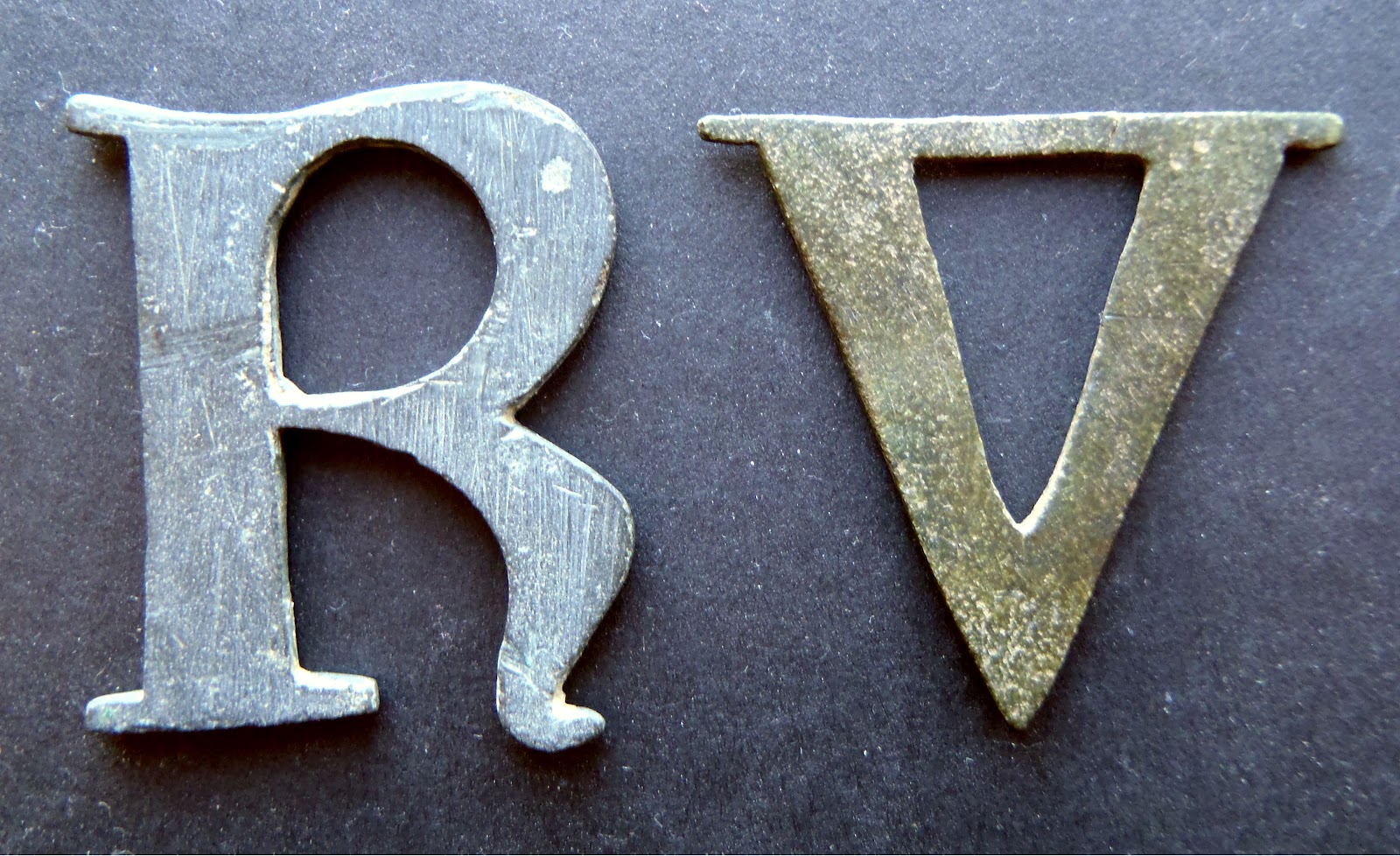
As often happens during research, an opportunity arose to acquire another example by serendipitous chance. Trawling through the British antiquities section of Ebay I spied a familiar shape amongst a mixed lot of old buckles up for auction. Up in one corner was what the seller clearly believed was a modern triangular harness buckle but I believed was nothing of the sort — it had serifs and I was fairly sure it was a Lombardic Uncial letter V, which is one of the most interesting letters of all because it can double as U in Medieval Latin inscriptions in the middle of words and triples as the Roman numeral 5 in dates.


It was very hard to gauge scale but I made it around the same size as the R and so I committed myself to winning the auction and succeeded seven days later at a fair price for a lot of old buckles. Just after Christmas the package arrived through my letterbox. I took a deep breath, opened it and carefully emptied the contents on my desk hoping I hadn't wasted good money on a pile of scrap metal.

It was thinner than the R but had the same rough reverse, smooth face, and was exactly the same size at an inch and half high. My instinct had proven correct — it really wasn't a buckle but another letter for what was now the start of a Lombardic Uncial alphabet collection!


Of course the thrust of this article is to inform the detecting public about these lovely and interesting finds so that mistaking them as buckles or whatnot, or binning them as 'hedgefodder' no longer happens. Of course that makes collecting an entire alphabet more likely because of awareness but more costly too because no-one should ever again sell a quite common Lombardic Uncial E or a very rare V as a buckle! I think I might get an I or O easily enough though... there's bound to be plenty of those lurking in detectorist's junk boxes unrecognised, unloved, and given the difficulty of knowing what they really are, eventually sold as what they never were or tragically, consigned back to the crucible from whence they came...

How long would it take to collect the lot? Well, a lifetime — two lifetimes! To be honest it's all but impossible, but until I complete the monumental task of collecting even a quarter, here's a collection of the letters I've found at various sources on the Internet. As you can see, it's almost half way there but there's a long, long way to go ~


PS. I've since found two more letters, the W and the Y ~


Tuesday, 18 December 2012

Trojan Horse Torpedo Attack — Bail Out!


Happily slaving away on my book on Sunday evening and things are going very well. All the front matter done and dusted, the introduction and 7 chapters complete with illustrations and the layout all set up for full bleed, perfect page design, footers and headers all working as they should and all I have to do now is keep going till the end, save it as as big pdf file and send off for the first proof copy hopefully by end of January.

Then I notice strange things happening. Something's afoot in the Mac's handling of things, it's slowing up and refusing to work as it usually does but it seems like a temporary glitch that just needs a restart to fix — it hasn't slept in days and the poor thing is tired and worn out...

I don't get that far before having it freeze completely —very unusual for a modern Mac. I hit the off button, and restart.

Flashing folder with a question mark

?   ?   ?   ?   ?   ?   ?   ?   ?   ?   ?   ?   ?   ?   ?   ?

Oh shit...

It can't find its boot folder! Noooooooooo.........

Restart...

Slow, slow, slow, but nothing doing. The apple Icon is there so it's found its boot directory but ain't able to get any further.

Restart,

?   ?   ?   ?   ?   ?   ?   ?   ?   ?   ?   ?   ?   ?   ?   ?

Restart, restart...

Then it comes to life, but like a zombie on methadone, however, I have a desktop, of sorts...

Save, Save, Save!

I stick a memory card in the back and after an age, its icon arrives with me. I open it, open other folders and start to ditch whatever I can onto it. First is recent work — the book files. They go, they get stuck, the Mac freezes mid-stream, and this goes on for hours, and hours. While I have it doing at least something though, I can at least retrieve the important stuff, the stuff that otherwise must be rewritten from scratch.

HMS Regardless has been torpedoed. There's a gaping hole below the waterline and it's only a matter of time before the inevitable happens. I'm there till five in the morning but in all that time manage to get only the smallest of document files off and whatever else I can pack in the lifeboat along with them before the good ship finally upends, gurgles, and sinks.

I've lost whatever wasn't backed up for good. The originals of ten thousand photos... they are kaput! All I have now is the copies uploaded to Picasa, and they'll never be fit for print at half resolution or worse. I'm resigned to the fact that I've lost all my stuff and all I care about now is the dread of having lost the computer to a hardware failure which would mean forking out £1,700 I don't have for a new one. Sod the passengers! Salvage the ship!

With gritted teeth I reboot the frozen thing and hope that I get one more shot at it just so I can insert the system disk in the slot and wipe the slate clean. If it refuses, all is lost. By a miracle it just has the strength and in goes the disk. It takes an age but its icon appears on an otherwise bare desktop, on which I click and command a total system overhaul...

I'm writing this, so I guess you know how it worked out. Two days of struggle later it's now as lightning fast as the day it was bought and though I'm missing certain crucial applications I can't live without and will cost half the price of a new computer unless I 'guest' them, I do at least have what can be got free and legit on the Internet and that includes the invaluable application the book is being created upon, Openoffice.

One day all data will be stored on the Internet you know. Computers will not need to store anything, just run. They wont even need applications because they'll just work over the ether and all be free to use too, mark my words. All you'll need to pay for is access rights, an annual license fee to a service provider who'll undercut the competition and prices will fall, fall, fall. Gone will be the day when you'll need to fork out the price of a second hand car for Adobe Creative Suite for just the few professional features you'll actually use repetitively. And gone will be the day when anyone will need to worry about being torpedoed by a Trojan horse...

But till then I have the sincerely held desire for the miserable low life who holed the Good Ship Regardless to one day go to hell where his scrotum will be pricked with needles, on the hour, every hour, for all eternity, and for his skin to itch ferociously and weep with pus each and every day of his worthless life till that day comes.