Thursday, 12 September 2019

Polly's Parlour — A Brace of Silver and a Blue Coat Button


There are three arable fields on the new patch and two have been searched enough to give a sense of how productive they might be in the future. Field 1 I think to be no good for much, but of course, you must never write a field off too early because any field may produce something special given time. Field 2 looks more promising and has produced already an item that dates probably to the sixteenth-century, which is by far the earliest find yet made.

Today I visited field 3 expecting to be just like field 2 because they abutt each, and in many ways it was. I encountered the very same spread of aluminium trash wherever I went together with the occasional chunk of anti-aircraft shrapnel — and this is clearly something that we will have to endure for so long as we search this patch of land.


I recieved a soft wide signal that just kept growing in size and scale and loudness as I continued to dig down and down in ever-widening circles. You have to keep going — such a thing might well be a hoard or a bronze helmet or a sword, or just about anything truly fabulous! 

I finally found the object on the top of the subsoil at about fourteen inches and it looked like bronze so I was very careful about extracting it. Unfortunately, as with most signals that go so very deep, it was disappointing. What it was I had absolutely no idea ... apart from the fact that it was certainly rubbish!


Later the ground gave up something better in the form of a silver buckle ring. It was broken but is repairable and it probably dates to the latter part of the nineteenth century. When I get the time I'll research the hallmarks and the maker's mark and give it a firm date and origin.

I'm always pleased to find finger rings and anything made of silver is always a bonus. The next find was very interesting indeed, and again of silver. An oval plaque that when wiped with a finger showed a hand-engraved scene and at the top —an inscription. More food for thought! And more research work for my busy digits!

There were a few more finds of interest to come. A lead loom weight, three shirt buttons, a crusty penny, a brooch that has seen better days but is something that originated from a Victorian church in our village - Salem Baptist. And then a small button that I reckon dates to the early nineteenth-century and is of the 'Birmingham Blue Coat School'.

My aim for any day's detecting is to come home with one decent artefact and one nice inscribed object be it coin, button or whatever. So, all in all, these two short hours were very well spent in my opinion.


Wednesday, 11 September 2019

Lead Cloth Seals — Augsburg, Germany, with Pine Cone Heraldic Badge. 1500-1650.


Lead cloth seal— Augsburg, Germany, with pine
cone heraldic badge. 1500-1650.  18mm.


The little coin-like object that at first, I believed was a button, on closer inspection turned out to be a cloth seal — what I thought was a crumpled and compressed loop on the reverse was actually a letter 'A' with a crooked bar. 

What could be more Post-Medieval than that? 

I thought that it might take some time to research, but I could not have been more wrong. I asked Judy to Google 'lead cloth seal' just so that she could understand what such a thing was used for and what they looked like in general, and hey presto! 

There it was! Another example! City of Augsburg, Germany!

Arms of Augsburg
I love lead finds when they carry interesting designs. I had this down as a pineapple but it's not one of those - it's a pine cone - and what I believed might be Prince of Wales feathers on top, just a very stylised interpretation of the capital of a column. I also had the whole design upside down in my head. The pine cone is supposed to be viewed upright.

Judy loves it. She has already begun to construct the story that lies behind its presence in our fields. 


Tuesday, 10 September 2019

Pineapple Feathers

Freddy carrying a brick in his mouth that he'd picked up in the stream at the bottom of the field.  Molly is still down there looking for one of her own. Quite why my dogs love to pull stones and bricks out of rivers I do not know but they take it very seriously! When I eventually reached the bottom of the field myself, the ground was strewn with them.
Another solo mission yesterday afternoon and on a different field than before. Time slot there was three hours and I decided that I would measure my recovery rate. I dug a total of 90 signals of which 15 were worthwhile finds, a few large chunks of iron, some shrapnel and the rest the scrap aluminium which seems to litter all of these fields. How it got to be there is now obvious to me because there are no specific concentrations of it and only an even spread that extends pretty much everywhere — therefore it was thrown out in muck-spreading operations. 

I still have to get to the bottom of the mystery of the IKEA cam locks of which we've now found five...

Thirty recoveries per-hour is good going. On my best Medieval fields down in Essex, I'd be lucky to get thirty in a full session of six hours! Mind you, out of those thirty a good hammered coin was always likely and a few artefacts inevitable. 

I've already decided that the first field we searched was probably lawned at some point and saw light activity during the nineteenth and early twentieth centuries. The mix of coinage found there was just what I'd expect from parkland. This new field showed a typical mix of finds that was the same as I'd expect from any random arable field, anywhere — a few 18th century tombac buttons, what I think is a uniface jetton, a harness stud, a hollow pewter item that is probably from a flagon or similar, an oil lamp wick winder, and a heavy bronze vessel handle fragment. 

Only when I reached the bottom of the field did I find anything out of the ordinary run of things. Firstly, a large silver coin that appeared from the ground reverse side up. Obscured by adhering soil, the design could have been that of any milled silver coin from the 1690's until the early 20th Century. It was one of the latest! An Edward V florin. 

A few minutes later another circular coin-like object appeared and without reading-glasses, just for a second, I thought it was a Roman siliqua. With reading-glasses, it was apparent that it was not one of those but rather a lead button with a curious design upon its face...

A pineapple? An upside-down pineapple with Prince of Wales feathers atop it? 

Whatever it was, I liked it!


Monday, 9 September 2019

Don't Mention the 'L' Word

Are you lucky,  or what?

Judy's technique improves swiftly, I must say! She's a willing student and I'm intent upon driving home the fine points of good practise, but of course, at this time there's a very large discrepancy between our abilities in the matters of locating, digging, isolating and pocketing targets at speed.

When I returned from a solo mission on the field that she had worked the evening before, she was astonished that during the same time slot of an hour and a half, I'd returned home with no less than eight items worth keeping compared to her total of just one... which she promptly lost!

"Jeff, how could you have been so lucky?"

"Judy, banish that word from your lips right now!"

"Which word?"

"The 'L' word! This is never a matter of that, and if you ever start believing that it is, then you will begin to fail. Once upon a time I did this every day of the week that I could spare and did it for fifteen years continuously. Let me tell you this — the 'L' word does not enter into it — detecting is simply a game of numbers. The only reason that I found more than you is that I dug more than you, and probably in the order of five times as much!"

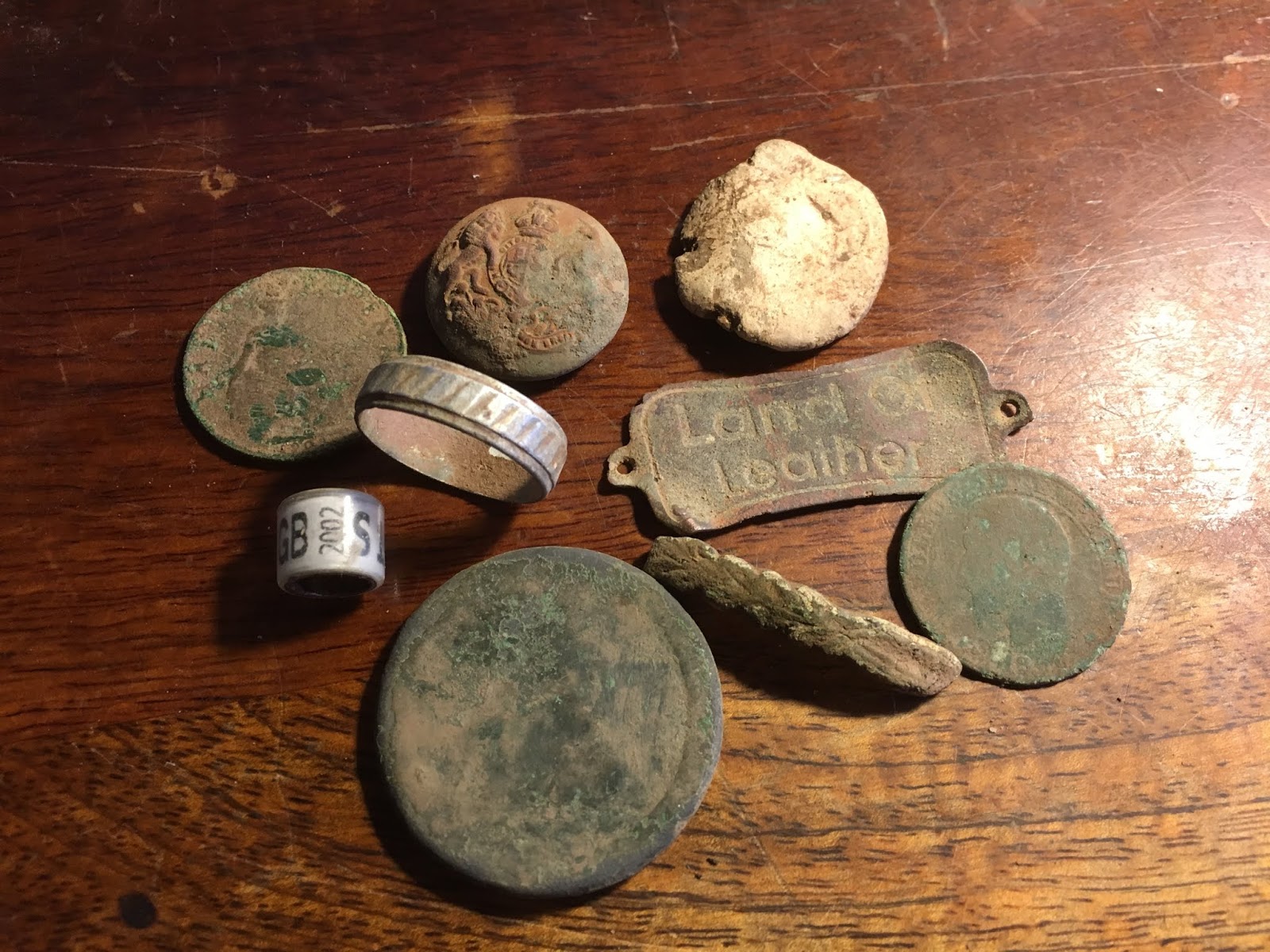
Edward VII half penny 1907, General Service button 1902-52, lead token, 'Land of Leather' brass tag - 1990's. Napoleon III 5 centime 1856, Part of an 18th-century shoe buckle, George III cartwheel penny, racing pigeon ring 2002, and the worst find of the day... some kind of trashy aluminium finger ring that when dug looked as if it was made of silver.
Of course, this happens to be true. I recover items quickly because I know that these barley fields will close come sowing time and will not open again till this time next year. I want a clear picture of what their potential might be by then and so I want to uncover as much information as I can in the time available this season. It is a brief window of opportunity that cannot be frittered away upon delays.

Time flies!

However, I do not fly across a field blindly thrashing away at the job.  I'll walk slowly and detect lowly, dig swiftly and accurately and isolate an item from the soil by rapid division of the clumthat it resides within. With wide overlapping swings of the coil that do not rise above the ground at their extremities, I just don't miss anything in my path. I will also dig 'iffy' signals that others might consider not worthwhile simply because so many in the past had turned out to be positive once a few inches of surface soil had been removed...

Hence the title of this blog... 

Judy cannot hope to match such speed in the short term and should not even try to. Bad habits are so easy to acquire but are so very hard to eliminate later and so for the time being she must endeavour to perfect good technique - and take her time over it. If so, then surely the finds will come for her!


Friday, 6 September 2019

Those People of Our Past & Us Detectorists of Their Future

Judy gets her first taste of stubble!

Our previous foray into our new fields took place back in June when a hay crop was cut - seemingly for our convenience! Of course, nothing is ever conveniently timed where farming and detecting is concerned and when we passed by just a week or two later the second crop of the year was growing abundantly and we could not resume our search there.

Finally, the arable crops were cut and we ventured out upon a new set of fields some distance away from the first. Here we saw that we had about ten acres at our disposal and half of that was permanent pasture which we'd save till wintertime. The arable land looked fairly unpromising to my eyes in that I could see very little in the way of obvious signs of past activity upon the surface. Just a few sherds of Victorian pottery scattered here and there, some fragments of clay roof tile too, but the soil not coloured by concentrated human activity or manuring.  Of course, that should not deter anyone from trying a field. We tried our best there for a couple of hours but the results were just as unpromising as the surface signs suggested they would be. Nevertheless, the dogs enjoyed it immensely and Judy had her first taste of stubble!
I noticed that even when she would put her full weight on the spade she had trouble penetrating the hard-baked surface and so I set to work making a garden border spade into a proper detecting tool. This is not a difficult task to accomplish with an angle grinder and a file and with across-the-counter prices for 'proper detecting tools' with the very same blade profile retailing at ridiculous prices, then DIY is, in my eyes, an essential economy. This wooden handled spade (and wood is best, I think!) cost just fourteen quid and half-an-hour spent cutting away excess steel then shaping, fettling and sharpening a new edge profile, transformed it into the best tool for the job. It was good quality from stock and I expect it to give many years service as it stands now. Over the counter, you might be asked to pay £45 for something similar that might well not... 

The next evening we chose to search for an hour or two in a field that my initial map research suggested might be promising. Fortunately, the stubble was that of barley and not nearly as punishing to work over as wheat stubble might be. For a beginner, I think wheat stubble might have proven too much of a deterrent, and even a seasoned pro might blanch at the thought unless wheat stubble is all that's available at the time. Judy managed it easily enough and she had plenty of signals to dig. Unfortunately, most of these were fragments of aluminium trash of which the field seemed to have far more than its fair share.

At last, she dug her first decent find - a half-penny of Edward VII and it looked to be in good condition too. Unfortunately, an hour later she'd lost it! She set off to find it again but I called her back from what would have been an utterly fruitless task in the half-light of dusk! And then I realised that I too had lost something - my high-power reading glasses, without which I cannot tell the difference these days between the half-pennies of Edward VII, George V or even Victoria... 

I've had people ask me how those people of our past managed to lose so many of their belongings for us detectorists of their future to find. 

I think that upon this evening we proved just exactly how that happens!


Monday, 3 June 2019

Target Practice - Musket Balls from a Georgian Firing Range.


Since relocating to Coventry from London way back in 2008 I have gone out detecting just a few times and then without any serious mission in mind. However, over the past few years, my wife, Judy, has developed a keen interest in Medieval history and especially the period of the Wars of the Roses. When I regaled her with tales of actually finding coins of the period with the heads of the monarchs struck upon them she expressed an interest in having a go at finding the same for herself.

Alas we had nowhere to start, but we were attending a rugby match at Ricoh Arena and at half time I went outside for a smoke, where I ran into a local farmer. I knew something of his land and so I asked for permission which he readily gave. The next day we walked our dogs to a couple of his fields and began instruction in the art of swinging a search coil.

Learning to swing with it...
She was fine with it, albeit a little unsure about how to use it effectively and swang the coil upwards on every sweep wasting half her time and missing half of her targets. After half an hour she had the swing mastered and began to find things. 

Nothing of any interest appeared until we came to a corner where she began to dig lead musket balls. Five were discovered in a short space of time and so I got the chance to explain a very important tenet of detecting theory - that people gather together for activities in discreet areas.

One these balls had in impact mark and so we discussed the idea that we had found the butts end of a firing range and this ball was one that had hit its target. Of course, then we thought that somewere nearby and within a few hundred yards at most, would be the best area to search for other items associated with this activity - the firing line.

The five musket shot recovered. These are not a type of ball that I'm familiar with, because each possesses no less than three sprue marks around the casting-seam. I am guessing that they were not cast individually but in a complex multi-shot mould. 


We did not find it that day, but no matter - the idea was locked in her head. And I think it to be a very important lesson to learn, for people in the past gathered together to do things in certain places and for good reason - and such places had boundaries outside of which very little will be found associated with the activities that took place.

Target practice!


Thursday, 15 October 2015

The Eyes Have It — Cracking the Thames Foreshore

Searching the Thames Foreshore in the City of London has always been one of my favourite ways to while away a few hours. Wandering about looking for likely spots and employing the time-honoured mudlark's method of 'eyes only' I usually find one or two items worth having in a day's work and occasionally something really very nice indeed.


Objects from Thames mud are usually in fantastic condition due to oxygen free conditions that halt oxidation and corrosion in their tracks so even ordinary copper alloy metal finds that from land sites might be dismissed as 'hedge fodder' come up almost 'as new' and that makes them special. Perhaps the best thing about the Thames though is that it's not all about metal finds. There's plenty else made of other materials, from wood, leather, bone and ivory, to stone, pottery and glass to stumble across.

A Charles I copper farthing in typical condition. Toned, but as fresh as the day it was struck


For a beginner the Thames is daunting. It takes some time to get used to the search methods and only long experience will tell you why you should be looking in the right places rather than the wrong ones. The majority of the surface has been picked clean over the years and in places where erosion has halted it's unlikely you'll find anything much but discover those spots where erosion, no matter how subtle, is taking place and that's where to be.

A Tudor period iron spur inlaid with silver. Such preservation is usual for ancient iron objects


In those areas you'll likely find collections of nails, wire, small pieces of this and that and mostly made of iron. These have collected in places where the motion of water has swept them and because of their similar weight and size, just like granules of gold in a prospectors pan full of river gravel, they separate from the matrix and end up in the same place. Amongst this iron trash is where far rarer non-ferrous metal finds are most often made. However, non-metallic finds can be almost anywhere because the same laws that apply to metals also apply to them but they have very different weights and sizes so they end up in different places.

It's also well worth investigating any lump of concreted iron you come across. The lovely spur I discovered was locked inside a large brown lump that looked interesting enough to warrant further investigation, but only when I went to work on it at home did I fully realise what I had. The concretions aren't that hard to remove so I'll take home anything that might come good. Inside the rusty prison can be a treasure waiting to escape!

How many finds in this one random picture? The Thames Foreshore in london is half man-made material...
You'll notice this is the bowed down approach and even this picture makes you feel a little motion sick. 


You have to know what you are looking for on any search. There's little point going to look for coins and buckle sized metal finds but expecting to also discover larger objects, and vice versa.  Small items and large items require two different stances and two very different kinds of concentration.

The first approach requires you walk about with your hands behind your back, legs straight and upper body bowed over with your nose as close to the shingle as you can comfortably get. This gives you just a small section of shingle in vision at any given time and when I find areas really productive of small finds or I believe are worth taking a detailed look at then I'll crouch or even get right down on my knees in order to focus really close-up. This is hard and focussed concentration.

Medieval Iron chain mail is rare, but it washes up in the iron rich
spots as do the very rare brass fringing links from the same garments
The closer you get to the shingle the harder it is to appreciate large objects right under your nose and you'll miss everything outside peripheral vision often walking straight past great finds just yards away without having a clue. So, the second approach requires an upright stance from which you'll see large objects clearly, miss many of the smaller ones, but be quite unable to discern anything the size of a Medieval farthing. This is a relaxed and broad form of concentration.

You cannot do both at once but in a day I'll employ both in rotation. I'll cruise for large objects and likely areas of erosion and then crouch over whenever I find those crucial collections of iron. This way I use the brief time available well, don't get back ache, and avoid the queasy motion sickness that walking bowed over all the time tends to create.

Shape and colour are important. If you go with the intention of finding silver and copper coins then expect them to turn up as they do on land sites — silver and green coloured respectively — then you'll probably never find any at all because silver coins from the mud are usually black or very dark grey and copper coins often bright and brassy if they've been freshly washed out or a light yellowish brown colour when they've been knocking about a while on the surface. I've never found anything that was green-coloured but pottery or glass or silver-coloured unless stainless steel!

Very large objects such as this fabulous 13th century moulding are there to be
found but because the face of such an object will be buried it has to be flipped.
What confuses matters even more is that coins are rarely spied flat and round but more often seen edge on or partially obscured. The foreshore is smothered in pieces of broken mussel shell that are black in colour and have rounded edges. These fragments need to be investigated when it isn't obvious they are shells because I've lost count of the times that a piece has turned out to be a hammered coin on edge by investigation.

Another consideration is flipping over any object that looks remotely interesting. Often the reverse lays face up and looks anything but special but the other side is highly decorated. The amazing hand carved Viking Age gaming piece I discovered was a startling example because when I first saw it I believed it to be another one of the perforated plain bone disks I'd found so many of. Only when I flipped it over did the decorated face appear.

And then there was the Medieval harness boss that looked just like the modern iron washers the foreshore is strewn with in certain places. I flipped it over and it had a brass face plate decorated in repouse work with a beautiful quatrefoil. That it had been crushed wasn't the point, it was a very rare find indeed and only one other of its kind is recorded!

In short, to make finds you have to investigate anything out of the ordinary and anything within the ordinary too because finds rarely present themselves clearly. If it looks worth the effort then investigate it — curiosity is your best friend down there, believe me.

What works against you is time. The tide waits for no man and all the while the clock is ticking. Get there as the tide ebbs away, exposes the first useful areas and start straight away. Only leave when forced off by the flood. You have just a few short hours in which to locate areas and make finds and those few hours must be used well.

There's are rules to be obeyed. You cannot use a metal detector without a license from the Port of London Authority and cannot dig down further than a few inches without being part of the Mudlark Society and having a special permit. Unfortunately, the society is a closed group, you must be seconded by an existing member and cannot simply apply for membership. The good news is that you do not need permits of any kind to walk on the foreshore and makes surface finds by 'eyes only' methods just so long as you do not scrape the surface with a tool, because that counts as digging and requires the appropriate permit.

It goes without saying that you should have recorded anything interesting enough to warrant it and take anything really interesting along to the Museum of London where the keepers will happily take a good hard look at it. The museum's enormous collections wouldn't be half as fabulous as they are without the many thousands of finds mudlarks have made from the Thames, you know.

Dead man's man's footprints. A 17th Century high-heeled silk shoe or an 18th Century square-toed leather boot? Experts at the Museum of London will know which or if it's something else entirely.  


Access points are not hard to find but I would not advise climbing up or down any ladder. The drop from the top of the wall to the foreshore can be as high as thirty feet and it's not worth the risk or braining yourself when a flight of stairs is usually nearby. I usually start making tracks toward a convenient exit point when the tide has risen above a certain point covering over the most productive areas, but it's actually hard to become stranded anywhere because the exit points are so numerous. Take a mobile phone in any case.

As for the reputation of the mud — it's not to be feared. Not really that dirty a place to be, it's mostly a very firm shingle and mud mixture with lots of tile and brick in it and walking about safely requires only a careful footfall, a slow pace and the avoidance of slippery rocks. I'll go down even in shoes I'm wearing on a day out in London and just wash the mud off on leaving.  I've never hurt myself in any way and have never sunk more than few inches, though I have seen others come a cropper. If it looks too soft then it probably is, so avoid it. You'll get your shoes filthy otherwise but it's unlikely be any worse than that.


And lastly, nobody will be looking at you as if you're some kind of social misfit these days. When I first started as a teenager I'd get coins thrown at me from above but since the South Bank at Southwark and Bankside was regenerated making it so very popular with tourists, loads of people began to enter the foreshore and have a dabble.

Nowadays it's seen as a legitimate pastime for all the family because you absolutely cannot fail to find something of interest. It might not be a treasure, but treasures are certainly there for the insatiably curious to find because London has been a world-class city for two millenia and arguably the world's greatest city for the last 300 years, so on any given day, at any given place, a few good things will always be visible and somewhere, believe me, there'll be a jackpot.

Undiscovered, then tomorrow they'll be in another mudlarks pocket or more likely washed under a stone and rendered invisible perhaps for years to come, but that's the whole point and appeal of 'eyes only' searching on the Thames. With any luck it'll be you who there's at the right place, at the right time, and with their eyes wide open to the chance.