Sunday, 5 July 2015

Thames Mudlarking — One of the Most Beautiful Finds I Ever Made...

...but when I discovered it, there was no Eureka moment.

It was just a skinny square object that was picked up only because I pick up and examine everything down the river that is clearly made of metal and not immediately recognised. I almost pitched it back to the shingle as a worthless blank piece of modern trash. But my better judgement kicked in. Nothing unusual once found must be left for others to discover. It is the law of the foreshore!

It had no detail at all, just a covering of a strange kind of slimy muck and therefore it did not go in the leather finds pouch hung safely round my neck where anything good gets to live. I pocketed it. In the crap pouch along with pot shards and encrusted iron requiring further investigation it went!

Under magnification it seemed that there was indeed detail of sorts to be seen. So I put it in the electrolysis bath, switched on the current, and let it be while I made myself a nice cup of tea. When I went back I was astonished to find that all the crud had vanished and what was left behind was a little jewel of a thing. Each side a tiny work of art.                                              


So far as I can tell, the two plates covering what remains of the thin flat iron tang are not solid gold, though they do appear to be. I think it must be heavily gilded brass. There's hardly any wear that I can see and so the gilt finish is as fresh as the day it was made. That's very rare with gilded finds. Usually gilding on metal is microscopically thin and easily rubbed away. As you well know.

It is a knife terminal, about the size of your thumbnail, and dates circa 1500. Originating from the Rhineland it was imported to Britain for sale or arrived here with its owner. It depicts a hare and a hound, a common enough hunting theme. I think they are both charming and delightful. Naive and yet artful. 

And to think I very nearly left them behind on the shore...


Wednesday, 1 July 2015

Thames Mudlarking — A Georgian Fob Story (Pt3)

What are our finds have if they aren't food for the imagination? Even the most trivial have something  small to tell us but best of all are those things that suggest an entire story. Even if the imagined tale is not what actually happened, it doesn't really matter. It is your yarn and that's all that is important.

Of course when you discover something and make it into something it is not then that's a problem. Imagination can and will make a silk ear out of a sow's purse but finds are only ever what they are and the facts must be established before you let imagination out of its pen. 


A watch would be have been 
attached to the top  hook
It wasn't so difficult to pinpoint with absolute certainty what this chain was. Though I hadn't much of a clue at the riverside, a quick scroll through a few of pages of Internet content gave me plenty of leads. I first thought it to be a lady's chatelaine — a chain suspended from the skirt from which were hung the keys to the house. 

Close. But not quite right. Turns out it once belonged to a gentleman and was part of his fob set. 

Fob watch, fob seal, key fob, fob chain. We're all familiar with those terms but I wonder how many know why they're called that. The 'fob' was actually a very small pocket stitched into a man's breeches and everything that tucked into it or dangled out of it had the word 'fob' appended. 

This pocket was very small indeed and the expensive watch a gentleman owned was stuffed inside. The tight fit made it very difficult to extract the watch so a chain was attached and it was pulled from the fob with it. Of course, this purely functional chain became more and more elaborate and soon fashionable dandies were hanging seals and watch winders and keys from the bottom.

The only trouble with this was that gleaming pendants hung below the waistcoat where they advertised just how rich a man was likely to be and therefore how much his concealed and costly watch was likely to be worth.

George III by Thomas Gainsborough.  Seals and watch keys on plain view

Of course such a visible and ostentatious display of bling made him a target for pickpockets. A sly lift of the waistcoat, a swift snatch at the pendants, a smooth upward tug — that was all it took to relieve a man of the lot. 

I have Georgian fob seals, watch keys, and a couple of watch casings too. They turn up from time to time, don't they? But how often have you come across one still attached to a short length of chain by a hook? Not often I'll bet. But if these items were lost rather than disposed of then many should be because surely the chain would break first, not the hook.

Am I suggesting that all these trinkets were jettisoned by pickpockets and highwaymen but not actually lost by their owners? No. But I am suggesting that more than just a few were and especially those made of base metals because they had no scrap value. Sure, a thief could prize the hard stone intaglio from a gilt brass seal and get something for it, but again, it carries incriminating evidence in the form of the victim's crest. 

If it ain't of solid noble metal or a carries diamond, emerald or ruby, then good riddance, chop, chop.

Georgian England was a not a disposable society. Things were not chucked in the midden till they were quite beyond useful function. (think leaden pot mends) Pennies to fix, pounds to replace. If it had been broken by the owner then it would have been sent for repair.

But there's not just a break in the chain, but three missing hooks too. And further, one of the two that remain was distorted by violent force. What's more, the monogrammed cartouche of the open-work plate, broken and distorted by what looks suspiciously like undue pressure between thumb and forefinger, also has three deep parallel scratches on its reverse made either carelessly or in haste by a sharp object or implement...

I think there's evidence enough to suggest shady goings on!


In Poultry, by Cheapside, London. It's late afternoon, on Friday 19th of October, the Year of our Lord one-thousand seven-hundred and eighty-one. Washington assisted by the French will this day defeat Cornwallis at Yorktown, Virginia, when the American Revolution will be effectively, over. 

   Shopping that fateful day for a well-hung cock pheasant and quite unaware that things will never be  the same for him ever again — Our Hero, Josiah Purswell — feels another truffling about in his silks, turns on his heels, only to find himself attached at the waist by his chain to a wall-eyed ruffian sporting a battered beaver tricorn in process of snatching his watch. 

   The thief is rumbled but thinks the prize valuable enough to risk a scuffle for. Knocking him down he yanks it from the fob but the prone Purswell fights back, battering him about the head with the bird, knocking off his hat and causing a colourful cloud of downy feathers to swirl around clogging his nostrils. Snatching up his hat the thief flees up Old Jewry sneezing, his victim back on his feet and in hot pursuit...

   The rascal might be the bastard whelp of a Covent Garden 'lady' but he's as fly as a Newgate Market butcher's dog from a lifelong career spent dodging. Purswell's thick-head from the previous night's excess of Madeira Sack at Boodle's coupled with the onset of gout in his left foot big toe put him at something of a disadvantage. Through St Olaves Churchyard, up Ironmonger Lane and west along Gresham Street he keeps sight of his assailant but there's an acute corner to turn into Milk Street where his wig slips across his left eye at the crucial moment. Into a dark and dank blind alley green with worts and ferns growing out the cracks in the mortar slips the thief, where he evades his hapless pursuant. 

   Resting a while in a shaded doorway he pulls out his folding knife. Scratching the back of the chain's monogrammed plate with its sharp point and holding it to his nose to check for the odour of brass, the miscreant finds that it's not what he'd hoped for. One chain is broken already but he can't tear the watch away from the two remaining. Unwinding the knurled collar of the hook he removes the captive timepiece, pockets it, then grasping the plate between thumb and forefinger yanks off each of the 18-carat baubles dangling beneath, one by one. 

   Checking his back, he hops over a brick wall into a yard and from there saunters through the city streets as casually as he can under the circumstances. Taking a circuitous time wasting route but in a generally southerly direction toward the river, he's hell bound on reaching Trig Lane undetected at dusk and there a wharf and its proprietor who's 'professornal' blind eye can be relied upon and who he knows 'wery well'. Luckily for him the tide had turned just an hour before his arrival and so the barges have all departed downstream assisted by the tide bound for Mersea Island to fetch cargoes of oysters.

   He looks about, finds the coast is clear, when he casts the worthless handful of evidence just as far as he possibly can into the Thames' concealing waters...

   Somewhat dishevelled and browbeaten, Perswell having given up the chase by nightfall bids a cab and returns to his Pall Mall pad. He's thinking he'll call on a Grub Street hack 'acquaintance' come morning to whom he'll tell his tale and try for a mention in the Daily Universal Register — hopefully securing some form of justice. Unshaken but cautious always, the pickpocket makes furtive progress across the bridge to Southwark, pockets laden with Perswell's loss. Heading to a consort's impoverished but spick and span apartment at Jacobs Island and within spitting distance of her creature comforts, he pauses. 

   Though she's always well pleased with a haul of silver coin, she just can't be trusted to hold fast her excitable nature, or her tongue, in the sight of gold. And so, he slopes back wearily to his grimy nest in St Giles rookery.

   The proprietor of our Trig Lane wharf, though, exercises due diligence. He always has (and always will...) take careful, detailed note of the evening, its characters, and its curious affairs. By his calculations whatever it was he'd witnessed tossed in the air fell short of intentions. So he'll go down stairs to the barge bed come midnight's low ebb and add what's discovered to his little mahogany boxfull of 'circumstantials' with date and time and name of culprit written down in black ink on a little card label attached with a short length of hemp netting twine...

   There's a lantern to light, and a pretty thing to find by it. He won't sleep till he has.


Ah, I could carry on all day long with this!

And you're believing my yarn now, aren't you?  But you do know what other meaning the word 'fob' has, don't you? 

To 'fob off' means to appease a person with falsehoods or dispose of fake goods by trickery. But I suppose that is exactly what a tale is, in essence. A fabrication of words that creates a picture so convincing that another takes it to be true and buys into it. 

Of course the chain may simply have passed out of fashion as all fashionable things must when whoever 'JP' was broke it up and threw it away in disgust...

But that's no kind of a Georgian fob story, is it?


PS
We still have fob pockets, though we don't really know what to do with them. You have one stitched into your favourite pair of jeans. It's that silly little affair in the right hand pocket that you fear to drop anything into for fear of not being able to get it out again. The reason it is there is because the first pair of Levis was made at a time when men still had their watches on chains rather than on a wrist strap. 


Sunday, 28 June 2015

Thames Mudlarking — A Georgian Fob Story (Pt2)

There's times when a discovery is so unusual and interesting that it demands that you sit down straight down on the ground, and stop. I was arrested and taken into custody. It was such handsome thing to have found that I couldn't quite believe I had. It didn't seem possible that such a delicacy could have survived two centuries in a puddle of mud without breaking apart into hundreds of tiny pieces and utterly destroyed.


Holding it up to the light and turning it over in my hands was one of those rare transcendental moments that mudlarks and detectorists experience just a few times in long careers. You know what I mean, I'm sure, because you've had them too. When you flipped up your first Celtic stater, or that lovely gold posy ring that now sits gleaming at the summit of the mountain of junk you've amassed. That was one of them, wasn't it?

On the shingle I sat for what seemed an age in reverie before the rising tide forced a move. When I got up I climbed Trig Lane Stairs, walked through the winding streets of the city to Liverpool Street Station, and there caught the fast train back home to Romford. Hurtling through Ilford at 100mph I realised I should have stayed on a little longer and worked at finding its missing parts...

Hardly a thing in this square yard of the forshore is natural. It's 95% man-made


Returning next day I wasn't sure I'd find more of it but I trawled through the pocket of mud it had emerged from and scanned the rocks nearby. Sure enough I did find another length of chain, a single link and part of a sprung hook. But it was still incomplete. After an hour or two spent dissolving mud in the Thames, sifting through the sand and gravel that remained behind, but without success,  I finally resigned myself to the certainty that I never would find another fragment. What was missing was probably missing when it was thrown in the river two centuries before.


It was quite some time before I had any notion about what might have happened just before it was discarded and why such a pretty bauble would under certain imaginable circumstances be too hot to handle. 

It is a gentleman's watch chain. At the time of its disposal it would have had the appearance of being made of solid gold, but it isn't. Gilded with a very thin skin of 18-carat gold (the only quality sold at the time) it would have appeared to be, but beneath the surface the time has exposed a sham because it's actually made of the eponymous alloy, 'pinchbeck'. This is a copper zinc alloy invented in the early 18th Century by the Fleet Street watch and clock maker, Christopher Pinchbeck, and so so closely does it resembles 18-carat gold that when the gilding rubs away, as it had with this piece, you wouldn't be able to tell.

Pinchbeck didn't intend to deceive anyone, It was simply his solution to a problem. Gold is too expensive to make large objects from so when a client such Louis XIV requires a musical clock but only wants to pay £500 for it, then a clock in pinchbeck is what he got from Pinchbeck. Of course it wasn't long before the jewellery trade was making items from it, and crooks passing their wares off as solid gold.

The metal became very popular with the gentry who would wear items made from it whilst travelling the thief infested roads of England. If they were waylaid and their possessions were stolen then the miscreants got away with metals worth almost nothing as scrap. It must have been a comfort for the victims to know that when the gang flew the scene of the crime and arrived back at the rookery, they'd set to work on the haul and discover that apart from what coin of the realm they'd pilfered, the exercise had been a waste of their time in terms of jewellery.

Of course they could still sell the pinchbeck items to their fence who'd pay pinchbeck price. However, when an item is marked with a monogram as this is, then no thief or fence in his right mind would have it. 

Traceable directly back to the victim it would have been stripped of its anonymous and saleable pendants and disposed of hastily. Failure to do so promptly may have meant lodgings in Newgate followed by a short a trip up the road to Tyburn...


I think that a plausible explanation of how this watch chain came to be where it was found. Criminals have always used the Thames as a convenient dumping ground for incriminating evidence and that is as true today as it was in the past. Every year I imagine there's an arsenal of firearms ditched over the bridges of London that are never found because they fall in the central channel. In Georgian times, though, there was only the crowded bustle of one bridge but plenty of silent and secret access to the riverside where hot property could be safely disposed of. 

I wonder if it's just coincidence that it was found in a puddle of mud about as far from the present day embankment as I could possibly throw it? 

Well, perhaps it is. 

But there's more to examine before I admit a riotous and unruly imagination and pitch this pretty chain of evidence into the Thames... 


Thursday, 25 June 2015

Thames Mudlarking — A Georgian Fob Story (Pt1)

The Thames Foreshore in London is a very peculiar place. Running through one of the worlds greatest cities, one that boasts a half-million year prehistory, a two-thousand year history, and was until recently the capital of the largest empire the world ever saw, the Thames is peculiar not because other great cities don't have rivers. Most do. It's peculiarity resides in the fact that it is narrowly embanked but also tidal. And so on a big spring tide the river can rise to within a gnats cock of the top of the wall but at every low its ancient detritus laden bed is exposed and accessible to all.

Spring high at Custom House


But it's a long fall down. Let's put it this way. Unless my life depended on it, I would never use one of the vertical access ladders. Luckily there are less dangerous steps spaced at fairly regular intervals. That means that your average day tripper out on a hunt can go down, reasonably expect to find things old and unknown, and go home with a handful of bits and bobs to adorn the mantle-piece. It also means the seasoned mudlark may reasonably expect to find something every once in a while that is not only very old but fit for display in a museum case. 

The discovery I made one sunny afternoon in May falls somewhere between those two polar extremes. Therefore it resides carefully stowed in my collection cabinet. Once in a while I get it out and look at it. I can't ever remember showing it to anyone.

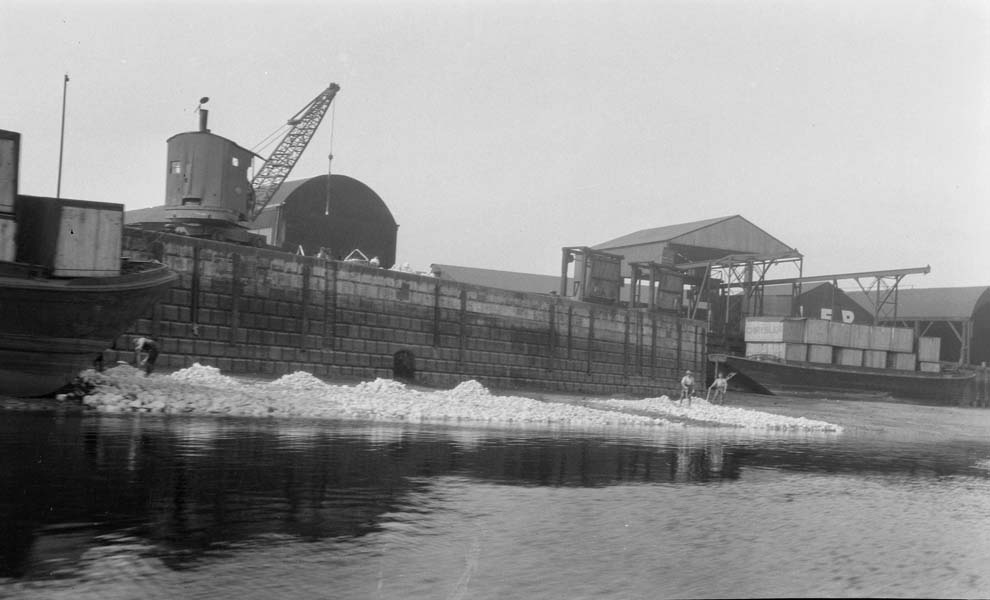
A chalk-rubble barge bed being laid at UDC Wharf, Chiswick on Easter Sunday, 1929. (MOL Collections)
The Thames was once studded with barge beds. Wharves that dealt in bargeloads rather than shiploads required them so that the flat-bottomed vessels would land gently at low tide on level hard standing where unloading would commence. Otherwise they'd tilt the load precariously making already hard work harder for the stevedors. The find was made on one. Nothing unusual about that — many finds are.

Thames finds, and the majority made on the North Bank in the City (which except for the opening at Queenhithe Dock was once an unbroken chain of barge beds) often aren't as many believe they are, direct losses. Stuff dropped by people over the sides of boats or thrown into the water when broken or unfashionable. Most often they got there indirectly and derive from these long redundant and derelict constructions.

Erosion begins when water having breached the wooden revetment begins its levelling work and begins to claw back its original course. The channel once begun opens ever wider at each and every turn of the tide till eventually the entire bed is reduced to loose rubble and shifting shingle, its stark oaken bones the only reminder it ever existed. A whole barge bed can be made nothing in a decade.
A barge bed at a busy Victorian wharf
They were made out of what was readily available nearby and the kind of stuff that others would otherwise have pay to have carted away. Compacted street sweepings, industrial and domestic rubbish and hearth tippings, demolition rubble and the spoil from new building foundation excavations (that in London will always cut through earlier layers and much older rubbish pits) and all kinds stuffs from all kinds of sources was piled in and rammed down hard. So much so that the beds are concreted throughout. All of this is very gradually loosened and freed by the very gentle but powerfully persuasive action of moving water.

The wood ash and fine coal dust is taken away in solution. The sand and gravel is washed here and there. The wood and the bone are light and are all taken elsewhere. The fragments of brick and stone, the shards of glass and pottery, are dense and heavy and remain behind. Amongst what's left will be bits and pieces of real interest and most of these are of metal often preserved so beautifully that they appear to have made the very day before.

However this find was made on top of the rammed rubble capping of a bed at Trig Stairs that at the time was fully intact. The revetment was whole and serious erosion had never taken place there and so the finds it contained were still locked inside.

How did it get to be there?

Well, I think that's quite an interesting question. To be on top I think it had to have been lost or thrown directly into the river, not dumped into a containing wooden frame along with a million and one other discarded things.

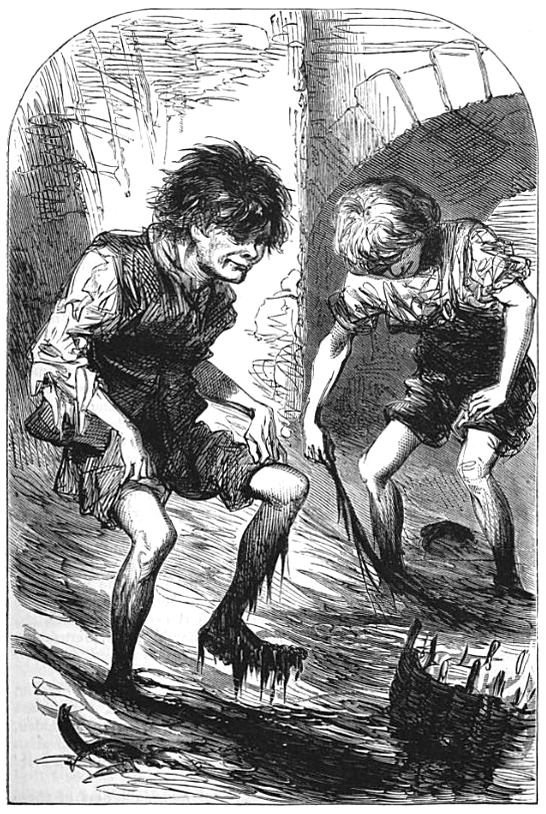
If so then its discovery was something of a miracle of chance, not because it hadn't been found by a modern day mudlark, but because in the past the Thames was scoured by daylight and lamplight by those with a rather more pressing and urgent need who weren't there to oik out a treasure but to eke out a living. And they'd hunt down every last valuable, saleable, useable, combustible (and God forbid, edible...) scrap they could find.

I always like to think of it as one of the many pretty trinkets from Fagin's lost treasure box. And it would have secured a poor mudlark's family food supply for a month, I'm sure. But they missed it. And so did everyone else for two long centuries. 

And then one day I was picking over a sloping shingle bed that had always been rather good to me and when I'd finished with it began walking westward across the intervening barge bed to another favourite hotspot, when the faintest glimmer of old gold caught the corner of my eye.

It was a fragment of chain. At least I thought that's all it was until I picked it up when I realised it was attached to something beneath the gloopy mud. Gently teasing the chain I couldn't quite get beyond five inches before it stuck fast so I plunged my hand right in, scooped my hand beneath the lot and lifted as carefully as I could.

The whole fistful came out quite easily so I walked back to the shingle bank where squatting at the water's edge, I immersed the grey lump in the Thames, and there began the careful job of washing whatever the hell that chain was attached to, out.


Sunday, 7 June 2015

Our History, In Pieces — Sprigging Luverly

Here's a nice desirable sherd of pottery and one that I had wanted to find for years before I finally did. It turned up in the most popular place for a family fossick on the entire Thames — at Bankside, and right outside Tate Modern. Quite how it had eluded others is beyond me, but there it was, half buried in the shingle and better, that patch yielded a number of other finds too. But that's how the Thames works. You don't wander off having found one thing. You stick at it right where the first find was made in the certain knowledge that you have discovered an area of fresh erosion that will continue to be productive until that erosion stops.


This is Roman 'terra sigillata' more commonly known as 'Samian ware', of course. A deep glossy brick red in colour, smooth and fine in texture and decorated with what's probably a legionary eagle. Surely there's no mistake about that. But hang on — what's that hole in the knob for?

Romans didn't drink tea... 

Not so far as we know, but the Chinese certainly did and when we British found out we built an Empire to rival Rome upon it.

The rise of the British Empire was fuelled by the stuff. It was the quintessential British beverage for three centuries and at the height of our power and influence late in the reign of Queen Victoria we consumed an astounding 6lb per person per year of dried leaf and fashioned teapots the size of pumpkins to brew it in.

As you can see, the teapot filled by the servant woman is rather small.
Hogarth's 'Apprehended by a Magistrate' from 'A Harlots Progress', 1732. 


Mercurius Politicus. September 1658
But in the beginning, our teapots were more the size of an orange than a pumpkin. And that's because tea was prohibitively expensive. It was more commonly available in coffee houses in the third quarter of the 1600's. The London newspaper, Mercurius Politicus, September 1658 announced,

'That Excellent, and by all Physicians approved, China Drink, called by the Chinese, Tcha, by other Nations Tay alias Tee', is sold at the Sultans Head, a Coffee house in Sweetings Rents by the Royal Exhange'.

At the time tax due was calculated from its liquid form. They'd brew up in the morning, the tax officer would quantify the duty to pay on the total pints made, it was kept on the boil all day long and dispensed in tiny cups for an appreciative public of gentlemen. But in 1689 the tax rules were changed. The leaf form was taxed instead (at about 25%) when it became available to anyone wanting to brew at home, but only to those very few who could afford to pay £10 per pound (equivalent to £1,000 per pound today!) and just as importantly, also secure the teapot in which to brew it.

Yixing teapot, 17th Century. Later repairs.
Probably the first ceramic teapots Joe Public clapped eyes on were those imported along with the initial tea consignment the East India Company brought back from Java in 1664. The shipment contained 100lb of tea worth at least £1,000 and perhaps more, but just £10 worth of these pots.

Alien objects made of a vitrified red clay the like of which had never been seen before and decorated with strange relief motifs that must have been quite a sensation to our eyes, they sold out immediately. Imports increased as tea drinking caught on but there were never quite enough pots to go round and demand was increasing exponentially so John Dwight of Fulham set to work to create copies. He never got beyond experiments and seems to have never sold a single pot, but a couple of Dutchmen did.

Elers Teapot, circa 1690
John Philip Elers and his brother David came to England, found a seam of the right kind of clay in Staffordshire, and created the first convincing British versions of the Chinese pots. But they ran into trouble with Dwight who tried to enforce his patent. Ignoring it they carried on regardless.

They sold but few. And not because the demand wasn't there. It was. Their failure was down to the fact that they were paranoid in the extreme about keeping their methods secret, each hand crafted pot was extremely time consuming to make and their products just too expensive for anyone but the most wealthy to purchase. The Elers brothers were declared bankrupt in 1700.

However, the Staffordshire 'potbanks' weren't to be defeated. By that time the tea trade was becoming less of a legitimate business and more of a criminal operation because taxation was spiralling out of control finally reaching an astonishing 119% by mid century. The gap between those who could afford this luxury and those who wanted to enjoy it was widening so far that, of course, smugglers stepped into the breach and supplied it tax free cutting prices (and cutting it with all kinds of other noxious stuff) to the bone. The huge demand had been finally met so the pots just had to be made somehow.

 The Elers had destroyed all evidence of their secrets and methods so initially the potbanks made lead-glazed earthenware versions. These were what we had till 1740 when finally they cracked it. Solving the clay supply problem by improving refining methods they made stoneware versions available at last and better still, threw the pots quickly on a wheel. The market was soon awash with handsome red teapots 'just like' the Chinese originals and cheap enough for the middling and perhaps even working classes, to own and enjoy.

Staffordshire redware 'crabstock handled' teapot, Circa 1760


The sherd under scrutiny is a piece of that history. It is the lid from a teapot and of course it's not a Roman one but a British one made in Staffordshire circa 1740-70. The decorations are known as 'sprigs'. They were formed in a mould, released onto paper, then applied to the damp body of the pot with a little brushed on slip. The dense fine clay is very strong but also takes sharp detail very well and that accounts for a great deal of the appeal. The bird is as crisp as the day it was made, and yet the lid is in a sorry state.

It may have been finally discarded only when the owner grew tired of trying to keep from falling into the pot because they were so treasured that people would use them till essential parts were unserviceable. Unless the pot itself was broken in many pieces and beyond water tight repair it would be kept and mended with new parts fashioned in wood, silver, tin, brass, pewter, and even poisonous lead.

The decorations soon departed from strict copying of Chinese motifs. By mid-century, at the height of Rococo style and our insatiable taste for 'chinoiserie', a delightfully eccentric mixture of sprigs in all kinds of diverse (and increasingly English) designs adorned them. My little teapot lid's bird sprig may look Chinese enough but it may have been accompanied by of all things, a Tudor rose! 


It's just a broken old teapot lid but I reckon I could flog it for £20 on Ebay given the current buoyant market for interesting sherds. I certainly couldn't afford to buy the parent pot in the one piece, though, because an ordinary one would set me back £500 and a rare and fancy one a thousand or two more.

Maybe instead I should list it as,  'Roman Samian Ware Teapot Lid — Legionary Eagle — RARE!'  

And would probably get £30 or perhaps more in succeeding to convince many that it really was...!

But knowing just half the truth behind this little piece of our history is better than peddling a half-thruth to others, so I'll keep it by. Enjoy it for what it is.

Because I think it's just sprigging luverly.


Monday, 1 June 2015

Pot Sherds — Our History, in Pieces

Visiting the Thames Foreshore recently has been quite a disappointment. I only ever practise eyes only searching there and in the forty years since I made my first find in the shingle I have never tried any other method. I rarely scrape, never dig, never detect with a machine. And I like it that way or at least I always have...

However, now I'm seriously considering other methods because the place is picked clean. Where years ago I'd go down and pick up thirty or forty items of non-ferrous metal, some of which would be nice finds, occasionally very nice indeed, now I can barely find two or three and only then by really pulling out all the stops and using all the knowledge acquired in my long mudlark career.

The reason is that nowadays mudlarking is a social event. Families do it, friends do it, every bloody bugger does it! Last time I was there I met a group of four young ladies out for a social fossick. Such a gaggle of hens would never have been seen years ago because the foreshore back then was a fearsome place where nobody in their right mind stayed for long. Nobody except people like me, that is. Those who enjoyed the brooding desolation, the frisson of danger, and the fact that the surface was littered with old stuff.

It still is. But I'm afraid it's littered with what old stuff nobody wants. Bricks and rubble and peg tiles, butchered bones and teeth. Those things that remain when all the nice stuff is gone. And by nice I don't mean hammered coins and pilgrims badges, I mean the sherds of pottery that once you could easily fill a carrier bag with are nowadays noticeable by their absence.

They have become a collectible in their own right. You can amass a collection from the Thames covering every period of British history from Neolithic to Modern if you know what to look for. Of course, the majority of sherds are going to be of relatively recent productions and will hail from the period of London's greatest might and power — the Post-Medieval period from 1550 onwards and into the modern era.  But it's all down there. And people know it.

The thing is, nowadays you cannot go and handle old pots without owning them yourself and that means paying a great deal of money for the privilege because even the most quotidian of 18th Century productions are going to cost well over £100 and the choice stuff, the Ralph Wood figures, the Bow porcelain, the salt glaze and the slipware platters are worth many hundreds and often many thousands. They are simply out of the reach of most people, unless that is they find bits of such desirable things on the foreshore, range them in a collector's cabinet. And they can do that because down there such a thing is possible to achieve, and for free.

Actually, there's something romantic about sherds of pots that complete pots do not possess. I know why people like them. They are small pieces of things hard to imagine in their completeness until you know what they are and have seen examples in the one piece. There's a mystery to solve meanwhile between finding one and finding its parent object through study and research. That's a very enjoyable process.

And it's one I want to write about here. So, I've decided to run an occasional series about pot sherds starting with a very interesting one that was missed by the new breed of collector I've encountered lately but was found by myself and in the most public and popular place on the entire foreshore — the South Bank right below Tate Modern.


Tuesday, 10 June 2014

Venus Victrix


It’s 1990 and I’m bored with my life, something is missing from it and for the life of me I cannot think what that crucial ‘something’ might be. We’re walking our dogs along the old track ways of Hainault Forest and wondering just how ancient they really were when my then partner, Rebecca, suggests I get a metal detector and find out… Three weeks later, I take delivery of a C-Scope 770d and my life is complete!

Early 1900's, publisher, Birn Bros of London, copyright lapsed
The forest was magical with its ancient pollard hornbeams, and was once the home of a famous hermit locally known as 'Old Dido' who lived under a tarpaulin but who left no trace behind for me to find. The woodland tracks proved to be Georgian at the earliest and though I made a few nice discoveries of coins and objects lost by canoodling Victorian lovers, I was soon finished with them.

I then had an amazing run of beginners luck on one small parcel of pasture digging what remain to this day some of the best finds I’ve ever made including a Bronze Age hoard, a gold noble and a Medieval gilt-bronze figure of St John the Evangelist. The gold coin was my first ‘hammered.’ That’s how jammy I was. But, all good things come to an end and it wasn’t long before I was short on finds and hungry for a new site.

One day out and about looking for pastures new I stumbled across a little cache of tiny child-sized thimbles in the grassy verge of a lakeside track. Investigating further I found a few buttons too, and then musket balls as well. Those finds proved to be the start of a passionate exploration of what turned out to be the most fascinating site — the long demolished remains of an early 19th Century gamekeeper’s cottage that existed for less than a century.

Copyright Jeff Hatt
Every find was a personal one. The husband’s military buttons of which I found three from the same tunic were of the Essex Light Dragoons and proved him an officer because they were of Sheffield plate and made in London by Samuel Fermin in the 1790’s. The wife’s cheaper costume jewelry was found too, but I’m willing to bet it was the children who lost them as discarded playthings!

Copyright Jeff Hatt
One day I’ll publish the complete inventory from the site but for now I’m going to present the ‘star find,’ the object that most captures the spirit and directly expresses the zeitgeist of those long forgotten times. It’s rude, salacious, and controversial. It’s also French. And that’s quite something considering the husband’s military life as a soldier in the Napoleonic Wars, but, one way or the other it came into their possession and was lost for me to find.


Copyright Jeff Hatt
For a long time I hadn’t a clue what it might be and even though the base had been drilled and tapped for a screw thread I really thought it might be Roman, so classical is the pose. Museum experts were stumped too, but decades later I learned the truth of the matter…

Pauline Bonaparte was the ‘first sovereign Duchess of Guastalla, an imperial French Princess and the Princess consort of Sulmona and Rossano.’ She was also the younger sister of Napoleon Bonaparte, the most famous Frenchman in history besides Vercingetorix.  She was quite a girl, a great beauty and used to getting her own way.

She was married off by her brother against her love for another to General Charles Leclerc. They embarked for Saint-Domingue to quell rebellion there. Yellow fever eventually claimed the life of her husband but in the meantime Pauline found the time to take ‘numerous lovers, including several of her husband's soldiers, and (was) developing a reputation for "Bacchanalian promiscuity." In her second marriage to Camillo Borghese, 6th Prince of Sulmona she had a sexual adventure with the virtuoso violinist, Paganini…

http://commons.wikimedia.org/wiki/File:Pauline_Bonaparte_2.jpg
Unawares, or fully cognisant of his wife’s promiscuity, in any case Camillo commissioned her portrait made in 1805, and in Rome by Antonio Canova, the greatest sculptor and most acclaimed artist of their times — and what a portrait it was! Semi-nude and she reclined upon a couch in fashionable Empire Style the result is a marble of beauty but at the same time also a thing of intrigue and gossip the news of which crossed nation states and by the evidence of this find which seems to be a tiny bronze copy of it, the English Channel too.

http://commons.wikimedia.org/wiki/File:VenusVictrix.jpg
Judged against the moral climate of the times a copy of Canova's 'Venus Victrix' would have been pornographic material. England at that time was in the throes of religious division and fundamentalist return to strict social codes of conduct where even the word 'leg' was deemed improper. Contrary to our ideas about the Victorians though, erotica was popular and even Victoria herself made and collected drawings of the male nude, but such a wanton display of a woman in her prime showing off almost every of her charms would have been seen as nothing short of disgusting to many a cold-blooded prude.


Our red-blooded soldier and father of the family clearly thought otherwise! This must have been his possession, surely, and perhaps a private one never seen by anybody else for that matter, at least not the children or guests, but perhaps from time to time and whenever the occasion demanded, his wife...


Was it acquired during military service in France at the Battle of Waterloo? After crushing Napoleon did he take home a model of his half-naked little sister posed as Venus the Conqueror as a trophy of his own victory? Ah, detecting throws up so many unanswerable but delectable questions doesn't it?

http://commons.wikimedia.org/wiki/File:Relief_Fondo_Fraia_BM_GR1956.12-4.9.jpg
And still, there remains a doubt. There's no exact Roman model for Canova's pose though one would certainly have been sought because artists always base their ideas on something already in existence. You'll notice there's a small but significant difference between the bronze and the marble. Pauline wears a simple band around her forehead whereas the bronze figure wears a full-blown Trajanic diadem...


After all is said and done, this may not be a copy after all — it may be the original thing.

http://commons.wikimedia.org/wiki/File:Aphrodite_Anadyomene_from_Pompeii_cropped.jpg