Tuesday, 1 October 2019

Map Research — Old Plots and Crossed Paths

We have a couple of fields nearby that we'd searched just the once and briefly then, but which Judy had expressed an interest in searching again, and so, on Sunday afternoon we set out to give them both another try.

This session was just a couple of hours in length but it was enough to establish a few points ...

I had done a little map research by overlaying Victorian maps upon modern aerial photographs of the area. I then discovered a few points of interest that I felt would be worth exploring further. Firstly, that there used to be a building on a small plot of land which once lay at the junction of the boundaries of three fields and that these boundaries with their hedgerows and ditches were grubbed up at some time in the recent past and all three enclosures were incorporated into a single larger field.

Map of 1883. Our permission does not include the two rectangular fields immediately above the brickworks. 
The house plot mentioned is at top-right and the crossed paths at bottom-right.


Secondly, I found that a footpath once passed by the building, which turned left and then right and then met with a second footpath which crossed the first. So, we also had crossed paths to look at, which I thought might prove to be more interesting than a path alone.

On the modern aerial map, the house plot and the original field boundaries were all visible. Even the second footpath which seems to have never followed a field boundary has left a faint mark.


Judy set out just to get used to what is to her, a newfangled sport. I had the house plot uppermost in mind. I set out to detect my way there from the field entrance at top-left and along the way found a couple of 20th Century coins and a Late Georgian period drawer handle. 

Judy looking bedraggled in the constant drizzle — and the target seemed hard to locate
Judy also discovered something that pricked her interest. Nearby to where I knew the house plot to be she'd turned up an apparently blank copper coin disk. However, I could just see something in the way of faint detail and we both agreed that there was a head on one side. Under raking light back at home the obverse seemed to carry a cypher or monogram. I thought it had to be an eighteenth-century farthing token — and it was.

Henry Hickman's Birmingham token of 1792. Issued by Henry Hickman, a wholesale and retail dealer in sheet, bar and rod iron - at 3, Edgbaston Street, Birmingham.


A proper grot! But Judy is proud of it and I have never seen one before.

Eventually, the plot was located by scanning the field surface by eye and searching for a limited but fairly dense spread of brick rubble, tile fragments and shards of glass and pottery in dark-coloured soil — and it was what I'd hoped for. The evidence found showed that it probably was a domestic habitation site and not some other type of building because the spread of debris included lots of pottery and also Victorian period clay pipe stem and bowl fragments. 

Oddly, although this field supplied plenty of signals, the house plot itself did not seem to hold a great deal more in the way of metallic objects than the land surrounding it. This seemed somewhat unusual, but we will see what comes of it all in good time! 

Later we set off for the crossed paths but never quite made it that far. The field in which they lay seemed unusually quiet for one that had a visible spread of pottery upon it and well-coloured soil too. Clearly, it had seen periods of manuring in the past if even it hadn't seen much in the way of on-site activity. Either that or others had detected it to near extinction in the recent past ...

But if so, then why not the top field also?


Monday, 30 September 2019

End of Month Round Up — September 2019

Stepping back onto a ploughed field for the first time in well over a decade was a special moment. All the memories that I'd accumulated during the many thousands of hours spent upon them in the past came flooding back. Those special finds that had kept me awake at night. Those thoughts that had accompanied the moments of their discoveries. And those journeys into the ancient history of England that they'd taken me on.

When I followed along in the footsteps of my wife as she crisscrossed the first field that she had ever stepped out upon metal-detector in hand, I realised that I was already following along in the footsteps of my own long-established routines. As her finds came along I was already constructing a framework to slot them into, was already establishing patterns of sense for them and was already predicting what might come soon — or even next.

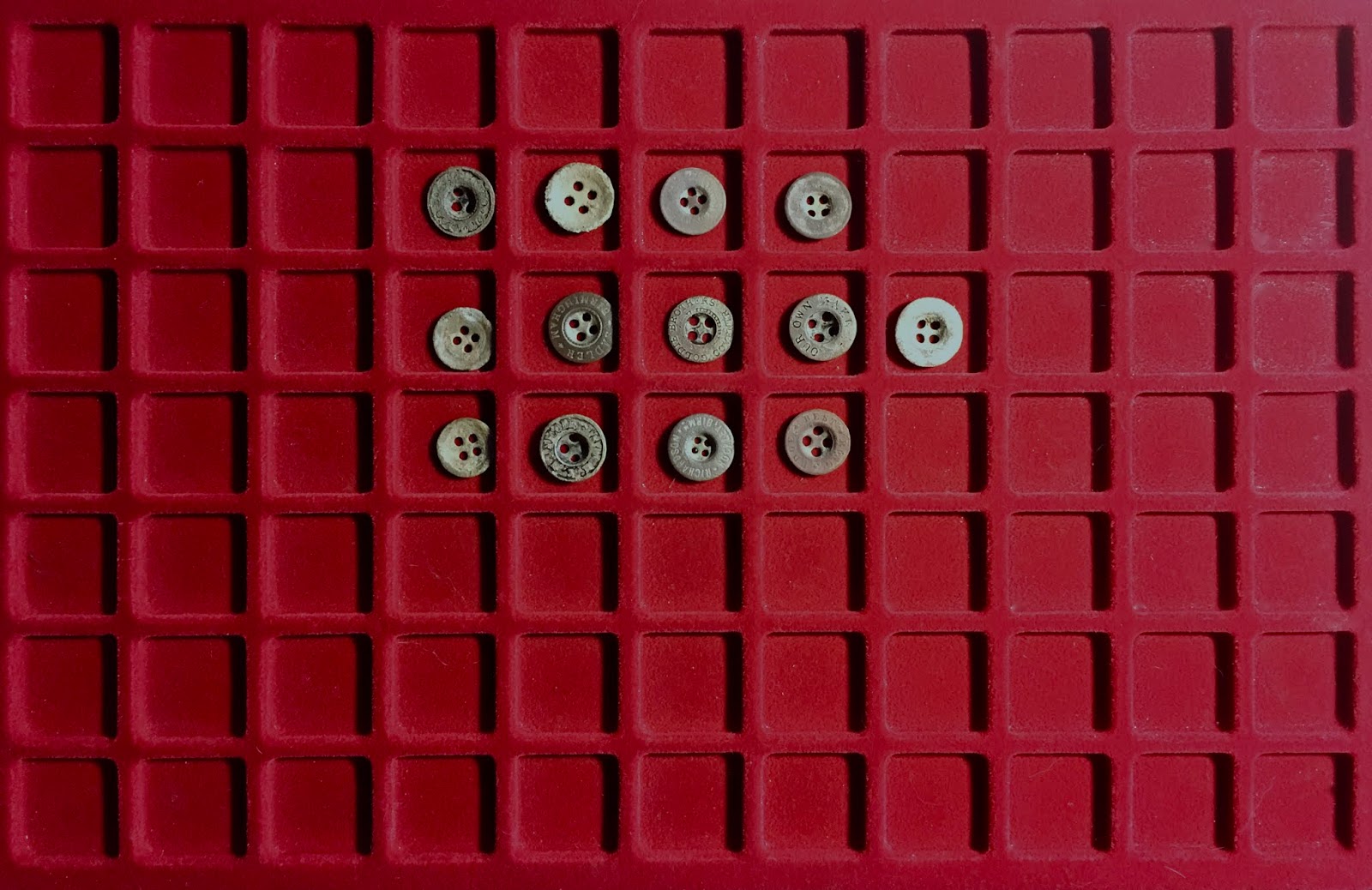
If Polly's Parlour keeps throwing a couple of these my way on every single trip, then I will fill this tray one day!
When I ventured out alone I discovered that one particular field (now known as Polly's Parlour) was really promising. There wasn't a lot to go on at first but soon a pattern began to emerge. Shirt buttons were found but at a rate that I had never encountered before. I know that shirt buttons are not exactly the most exciting find in the world but the point is that they were there in some quantity. To my way of thinking, when anything turns up in an arable field 'in series' and in discreet areas or along certain lines of direction then it means that they were probably deposited there not through the rather uniform mechanics of muck spreading, but were lost or discarded on-site.

And if one of these turns up on every other trip then I will amass a serious collection!
When I began to find lead and pewter toys in addition to the shirt buttons, I thought this rather interesting.  Shirt buttons alone would not have had the power to pull me back, let me tell you! These toys must be clear evidence of children at play within the field. I have never encountered any field that has ever produced so very many. In point of fact, I had found a few lead toys before and thinking back, these were all from a demolished 19th Century cottage site and its gardens, but I could not remember a single one that had come from any of my open fields.  

There are two deer, a Native American warrior on horseback, the head of the Victorian jockey, 'Fred Archer' and Judy's first proper find — the wheel from a toy train. That they have absolutely zero monetary value in such states as they exist now, well that's really not the point to me — for they do possess a certain aesthetic value that I find really satisfying. They remind me of a collection of Roman figurines and votive objects in many ways. The missing limbs. The uniform colour of their cream-coloured patinas. All this binds them together really nicely as a collection and I do hope that I find more and more of them. 

But how about any older finds? Those kinds of finds that metal detectorists are supposed to obsess over when they step out onto the arable and the pasture? Well, I'm afraid that I found very few items to obsess about at any great length ...

There was the top of a trefoil spoon — 17th Century. A very corroded gilt-brass belt mount used as a suspension point for something — Medieval. The lead cloth seal carrying the Arms of Ausburg, Germany — 1500 or later.

I really don't think that this particular field is going to produce much in the way of truly ancient objects and I do not care overmuch about that, to be honest. Just being out and about in the fresh air, with my dogs frolicking about in the river whilst I occupy myself with the pleasant task of digging up lead toys and brass shirt buttons — well, that's quite enough ...

For now!


Saturday, 28 September 2019

Garret Pro-Pointer AT Air Test


Although I was a greenhorn handling two unfamiliar machines on my first attempt at a field test, I did learn how to use both pretty quickly and under increasingly uncomfortable conditions. 

I thought that something was wrong with the Garret probe when it located a large harness buckle at only an inch or so from the tip. Initially, I thought this to be a very poor performance but then I thought about the fact that the probe has three sensitivity settings and that I probably had it set on minimum. 

I was right. It was set on minimum. And so I used a coin to check these three settings against. This coin was a 1690's William III halfpenny which is a good-sized target at 28mm diameter face-on, but with only a 1.5mm thick flan, a tricky one edge-on. The results were rather interesting ...

William III halfpenny — 28 x 1.5mm, copper
Sensitivity 1.  Face-on — 31mm. Edge-on — 0mm.
Sensitivity 2.  Face-on — 53mm. Edge-on — 17mm.
Sensitivity 3.  Face-on — 71mm. Edge-on — 25mm.

And then I checked the three settings against the large harness buckle found in the bottom of a 9-inch hole which in the ground seemed to have been located by the probe at about 25-30mm from the tip. It is quite a large object at 43x30mm and as an open ring of solid metal I thought the probe would start beeping at a considerable distance. Also, with an edge profile of 5mm, I expected good results edge-on ...

Harness buckle — 43 x 30 x 5mm, brass
Sensitivity 1.  Face-on — 45mm. Edge-on — 16mm.
Sensitivity 2.  Face-on — 82mm. Edge-on — 38mm.
Sensitivity 3.  Face-on — 102mm. Edge-on — 53mm.

All the results above were measured from the very tip of the probe only. However, the probe is also able to locate items along its side and all the way up to the on-off switch which is about 4.5 inches from the tip. The face-on distances achieved were somewhat better than those at the tip and seemed to be quite regular all along the length of the side. However, though edge-on distances were also far improved compared to those at the tip, they were not quite regular along the whole length ... 

As an example, when presented edge-on to the tip of the probe, the coin would not even register on 'Sensitivity 1' unless I tilted it slightly. Along the side of the probe, it registered at a maximum of 20mm but this was only in the centre of the side of the probe with the detection distance trailing away from the centre toward the button and the tip. 

For 'Sensitivity 3' the improvement in the detection range for the coin presented edge-on to the side of the probe was simply enormous. It was seen at a range of 64mm compared to 25mm at the tip. However, the range that the probe detected the buckle both face-on and edge-on, was most interesting. It registered at 88mm for both! 

This probe really is a metal detector in its own right, and I'm really glad that we bought it! I can foresee that I'll find a number of other uses for it besides those of arable and pasture work...

It's quite expensive. No, it's very expensive! 

And as a detecting couple with just the one between us, of course, we will have to buy another! 


Wednesday, 25 September 2019

Polly's Parlour — XP ADX150 & Garret Pro-Pointer AT Field Test (Part 1)

Not so straight-out-of-the-box, slick, pristine and modern-looking now, eh?
Either I had miscalculated or the weatherman had. The rain predicted to arrive in Coventry at around five in the afternoon came early and of course, I got caught out in the field. I had about half an hour of dry weather beforehand but then it started to spit continuously and carried on drizzling for the next fifty minutes after which I packed up and headed home.

And so my field test, which was to be two hours in length, was just 1 hour and 20 minutes in duration. No matter; it was enough time in which to get a feel for the field performances of both the XP ADX150 & Garret Pro-Pointer AT.

On the previous day, I had set the 150 up for Judy on full sensitivity and minimum discrimination but thought that that might have caused her a few problems. And so, today I set it up at the default sensitivity, which is marked with a red arrow on the dial, and notch 2 for discrimination.


The ADX150 had 5 targets to achieve.

1. It must get me to dig at least thirty signals per-hour that will result in non-ferrous objects.
2. It will find large pieces of coke, though not small fragments unless on the surface.
3. It must find small items in the top six-inches and very small items in the top three.
4. It will knock out small ferrous scrap but should allow me to find and remove larger pieces.
5. It will prove itself for good depth if a very faint non-ferrous signal would be encountered.

These requirements are only what I generally ask of the Laser B1 everywhere and more specifically, what it has proven itself capable of doing on this particular field — in essence, the two machines were going head-to-head upon a known environment where the XP ADX150 had to match up to to the Laser B1 on five scores already established there as desirable ones...

Or else!

Initially, I'd set out with the 150 on loud-speaker but within ten minutes I'd fished out the supplied headphones and plugged them in, because, competing against the background noise from the nearby busy road, I could hardly hear enough audio information to be certain of anything but the very sharpest, cleanest signal. The difference was remarkable. All of a sudden the machine was intelligible and signals were easy to read. The tone was a bit squelchy sounding to my B1 ears, but I could deal with that. The finds rate soared and it was clear that the target of 30 recoveries per-hour would be achieved and perhaps even surpassed. And yes, it did respond to large pieces of coke but ignored fragments, and so it hit target number 2 also.

Unfortunately, not a Lizzie I shilling... But for just a sweet moment - it might have been!


I began using the AT probe. Because the soil was fast becoming soppy it was a boon not having to divide it all by hand. It was fast and accurate but it seemed that I had to have the tip very close to the object before it would register. I thought that this may well be down to sensitivity settings and so I decided to experiment with those later. The way it was set up would just have to do for now because it was covered in mud and I needed to re-read the manual!

The bright orange colour is good, though. If it were dropped somewhere you could see it a mile off! The continual beeping alert should you stow the device back in its holster without turning it off first was great too and will avoid running batteries down needlessly.

Because it was performing well, I wondered if the 150 would uphold not only the overall recovery rate per-hour for this site, but also achieve the expected outcome of at least one shirt button, at least one coin, perhaps a toy and a surprise item too?

That's a big ask in a shortened session!

Well, the shirt button was duly located (unbranded...) and so it can find small items in the upper levels of the soil. However, I must say that it did not seem to be locating quite as many very small targets as the B1 would have — in fact, the shirt button was one of the smallest finds made during the session and though there were other finds as small as the button, nothing was found as diminutive as a cut half or quarter-penny. However, this is not yet alarming. I simply may not have passed over anything so very tiny as that.

So, target 3 was partially achieved.

Target 4 was hit when I dug a positive signal that I could not easily find in the hole until the probe located it in the side-wall. It was a piece of iron the size and shape of a Havana cigar. Top marks for the probe!

And as for target number 5?

Would I even come across a very faint, non-ferrous signal?


The answer was yes, I did. It was a soft sweet signal and good in every direction but just a whisper really. I expected iron as I dug down 4, 6 and 8 inches. The signal became a little louder as the soil was removed, but not by much. The probe could not find the object at 4 or 6 inches but at 8 inches it finally located the item which proved to be a large brass harness buckle laying on its side, plumb in the centre of the hole and at about 9 1/2 inches in depth.

Two 'coins' were also found, but one proved to be just a thin disc of brass and not a coin at all. No matter, it was coin-shaped. And then, with the 150 having hit almost all performance targets and having achieved some of the expected outcomes too, I was satisfied and so I began to wind my way back to the gate.


Along the way, I stopped and dug a loud positive signal and flipped up something that was felt by its weight alone to be just a lump of old lead...

But it was not just any old lump of lead. It was deer number two and yet another toy added to our growing collection from this interesting site.

As I said in the previous post — the numbers never lie!


Tuesday, 24 September 2019

Polly's Parlour — A Boy's Toy and The Most Peculiar Enamelified Thingy


Our first outing with the new gadgets was planned for Sunday morning. We expected our son, Ben, and his girlfriend, Sophie, to arrive at ours at some time in the afternoon. Plans change. Nothing came of the arranged arrival due to late at night partying activities on Ben's part — or something like that. I don't really know for sure what happened because I heard the news second-hand whilst earwigging Judy's phone conversations.

All that I knew was this; that Judy would use these new gadgets this very day, and I was determined for that to happen!

In the end, despite endless delays and dallyings, we finally got out to Polly's Parlour in the late afternoon and left the dogs at home at my request because I wanted to monitor the performance of both new gadgets and also my wife's progress in the field.

You may ask why go to Polly's Parlour and not to another of our fields?

That's because it now has an established track record that suggests no longer what is only possible on any given session, but what is actually probable. I have a set of firm statistics already and can measure unknown quantities such as Judy's current finds rate and the new machine's efficacy against them. Calculate odds, if you like.

OK. In advance, I had calculated that I would dig around 30 targets per hour over our allotted two hours and would certainly find at the very least, 1 shirt button — and this button had better than a half chance of being a branded example. I would also have a very good chance of finding a child's toy, would certainly find at least one coin and that coin might well be silver but most likely bronze, and that there might also be a surprise find in the offing. Something intriguing...

All of this almost came true for me. And that is why I love numbers, so.

The shirt button was secured within ten minutes of the off, was in very good condition for the site, and was branded  — Richardson of Hockley, Birmingham. Later came a crumpled 'badge' inscribed with text that at the moment I cannot fully decipher but it contains the clear word 'LODGE'. Two coins were found also but alas, both were bronze. And then the surprise find duly turned up...


I hadn't any kind of a clue what it might be at the time of discovery and still have not. It's most peculiar and does not easily fit any categories that I am familiar with. A large irregular cabochon of variegated white, blue and purple enamel held captive within a circular copper-alloy 'mount'. A copper-alloy 'mount', I might add, that shows no sign whatsoever of having once been gilded. The reverse of the object is odd. It possesses six irregularly spaced drilled perforations around a larger central perforation which appears to have been tapped with a screw thread ...

At first glance, I thought it might well be a late Saxon enamelled brooch. However, with the presence of a screw thread as a means of affixment to its host object then it must be fairly modern, surely?

A little later Judy shouted across to me that she'd found something similar nearby. She had. Only it wasn't...

She had secured the one item missing from my list — a wheel from a boy's toy train!

That's four toys dug from this site now and more will surely come because the numbers say that they will. Mark my words — numbers never lie!


Monday, 23 September 2019

XP ADX150 & Garret Pro-Pointer AT — First Impressions

Having Judy start detecting was a matter of her swinging the machine with me tagging along behind helping out in whatever way I could. When she became proficient enough to go solo I realised that I would have to do my homework and find a suitable machine for her. And so I set out to find one that would suit myself...

I know that may sound mean spirited but really, I did not think about it that way. My thinking was logical. Because she does not want to cover large tracts of land (which is my preference until I find a concentration somewhere) and would prefer instead to concentrate diligently and thoroughly upon one area of choice, then I thought a deep-seeking detector would suit us best. We would then have a happy division of labour. I find the hotspots — she works them.

And of course, it would suit me too because I already own the best tool for the job of taking out surface finds — the Laser B1 — and so a machine that was deep-seeking and very adjustable would be a useful alternative that I could employ under conditions that would defeat the rather shallow-seeking B1. 

The Laser B1 set up as I usually would. Maximum sensitivity and minimum discrimination!
The B1 may be a beast where rapid recovery of objects from the top six-inches is concerned and a peerless tool for extracting tiny objects from the top three-inches, but when I waved a cartwheel penny across the coil and it gave me a faint signal at just ten inches, I thought that a future problem. We have only about 70 acres of land at our disposal (so far as I know...) of which half is permanent pasture. The B1 will struggle to do well there once the surface finds are cleared and if older finds are way down in the ground then it's only going to be good for clearing modern trash...

My decision was to go to Regton in Birmingham and take a look at the Nokta Makro Multi Kruzer. I'd seen a few videos and the air and in-ground tests performed were impressive, with the machine picking up signals from various objects at almost twice the depth that the B1 could achieve. A cartwheel penny would have come in at probably fifteen inches or even more! This seemed suitable. 


Unfortunately, Regton had none in stock and apparently, there are none in stock anywhere because of a fault with the machine. And so we came away with precisely what I did not want but exactly what a beginner really needs which is an ultra-simple, one-tone, switch-on-and-go detector — the XP ADX150.

Of course, we also needed some extra kit.  Judy liked the idea of using a probe and so we also bought a Garret Pro-pointer AT 'carrot' while we were there. I have never used a probe myself because it seems like an extra operation to perform when the speed of recovery is of the essence. I will just divide the clod by hand and wave each half over the coil until the find is located. But I can see why it would prove essential on pasture land. 

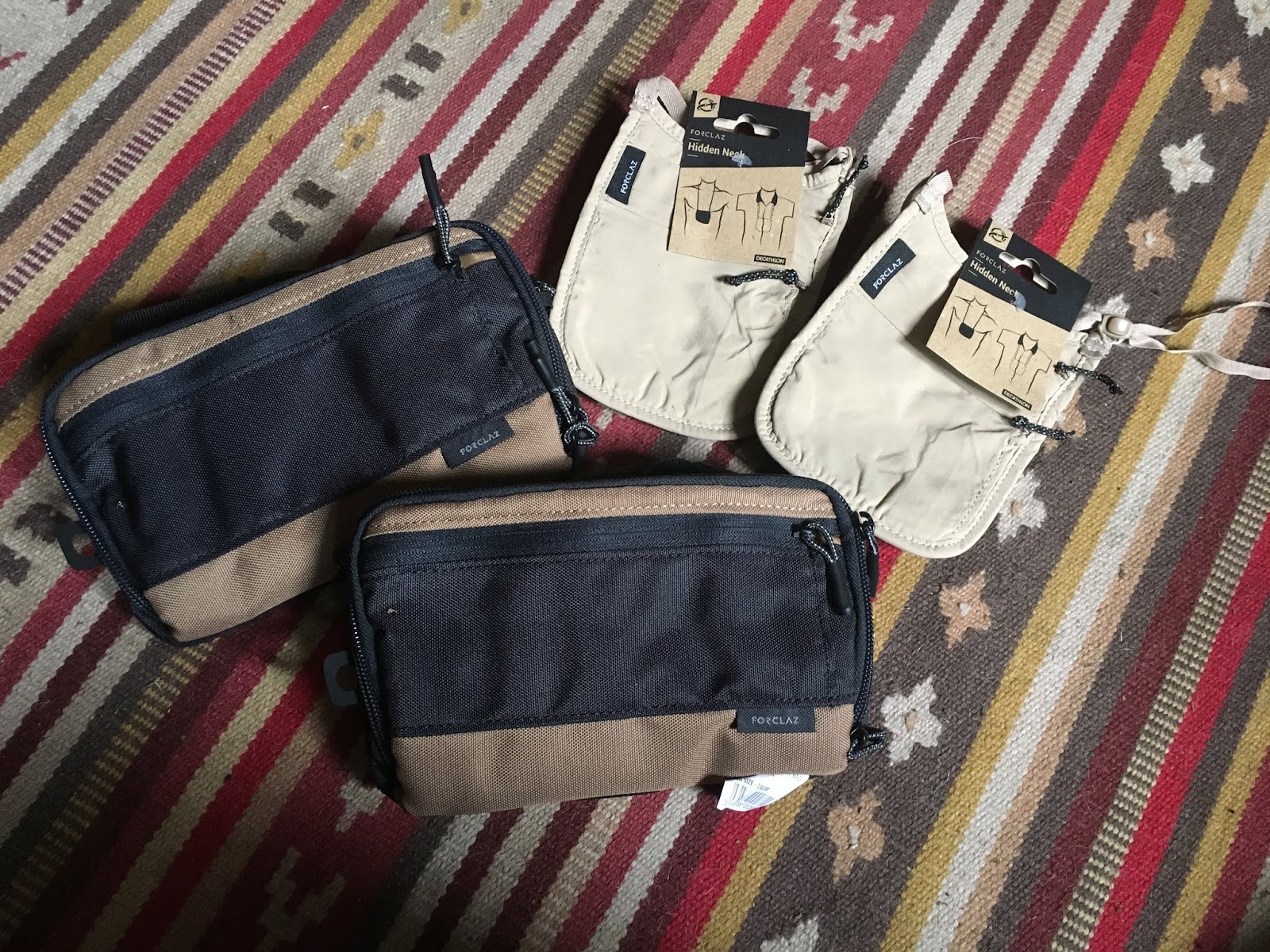
I also purchased two bum bags and two neck pouches from Decathlon. These neck pouches are where valuable finds will be stashed and they hang inside clothing where they cannot be seen, snagged or lost. Finds are dropped in and never taken out again till I reach home. I have good reason to employ them because through bad storage (trouser pocket!) I once lost a 17th-century pendant crucifix from the Thames Foreshore that I had only picked up an hour before. I vowed to never lose a good find ever again. 

We also needed another spade but my preferred tool was out of stock at the store nearby home and so we had to make do with a puny trowel in the meantime, or rather I had to!


In the house, her pristine new machine, made my old Laser look like some kind of antique! However, looks can be deceptive and out in the field, it was soon apparent that the Laser outperformed the XP on a number of scores, the first of which became apparent when I saw Judy creating an ever-widening spread of soil.  I went over to help her and she said that she'd lost the signal somewhere and could not find it again with either the 150 or with the carrot. She swept both across the area and sure enough, neither registered a signal. 

And so, I asked her to remove both the detector and the probe from the area while I swept the B1 over the same. The signal it gave was loud and clear and was certainly a 'digger'. Having located the item I then set to work with the 150 which utterly failed to locate it. And then I went to work with the probe which also failed until I had spotted the target by eye which was a tiny scrap of aluminium. I had to push the tip of the probe right on top of it before it beeped ...


The second problem was that when a target was located which was actually a large chunk of iron that it could not screen out completely then it would register as a perfectly positive signal no matter how close the coil got to the target. This is because of the way the 150 works. It seems that a signal is either a good one, or it does not sound at all. It's either there, or it's not. 

Judy was having trouble digging such a target at depth. One pass of the B1 dismissed it as the junk that it certainly was by means of a cracked signal. Of course, there's no point in leaving such junk in the ground on your own fields and so it was removed. However, at a detecting rally, I would want to pass such junk by as quickly as possible, not have to dig for ten minutes and then cart it around with me! The 150 would demand that it be dug ...

The third problem was that I always run my detectors without headphones. This is because once I was using headphones with a threshold tone detector — the C Scope 770D — and could have easily lost my life to a very angry bull who I did not hear approaching me from behind. I have been averse to the use of them ever since. 

The loudspeaker tone of the B1 is loud, high pitched and very insistent. When you get a signal you are aware of it even near busy roads and motorways. It says "Dig me!" The tone of the loudspeaker of the 150, by comparison, is mid-pitched, rather too quiet for my liking and somewhat vague to my ears. It says "You can dig me if you like...'

It's too early to dismiss the 150 and the carrot. I will have to use them myself and experiment with settings (and God forbid! headphones!) to establish how best to use them both. For Judy's first outing I had set up the 150 'wide-open' just as I would usually set up the B1 for my own use — maximum sensitivity and minimum discrimination. This may not be the best way with the 150 on this land and it may have cost her a few targets. 

I don't know as yet and I am keeping an open mind, but I will report back after my own field test is completed.


Thursday, 19 September 2019

Polly's Parlour — Victorian & Edwardian Branded Shirt Buttons

Some time ago I met a local man who I had never met before upon the modern bridge that spans the stream that runs through the bottom of our current fields of interest. We talked about fish — because I was then very interested in this stream and its fishes because it does hold good stocks of them these days due to its current state of rude health. According to this ancient fella — when he was a very small boy, he and his friends swam and paddled there and discovered that it held populations of 'stony loaches', which is a tale that would have been true, for it once did (and it even may now!) 

And then the conversation moved along ...

He then told me that the general area of the stream that we now stood above was once known as 'Polly's Parlour' and was a place where people came 'to enjoy themselves' — which intrigued me no end... What on earth could 'Polly's Parlour' have been? What would have prompted such a name when there was nothing of a parlour nor anything like a parlour to be seen there?

The field that has been producing evidence of 'people enjoying themselves' directly abutts the area described, and given that it might have been part of Polly's Parlour or even Polly's Parlour' itself, then I have named it as such! 

Every field needs a good name, don't you think? And 'Polly's Parlour' is a very evocative name indeed!


What I hadn't banked on was becoming a collector of old shirt buttons. It's not that I have a particular want to —  it's just that they are frequent finds in Polly's Parlour and so a collection is forming of its own volition!

What is interesting about these shirt buttons is that some carry the names of the local drapers and outfitters who sewed them upon their shirts as a means of brand advertising. There's H J Nicoll of 39 New Street (Birmingham), Sadler of Birmingham, two that may carry brand names but are too corroded to decipher (yet!) and the star find, Goldie Brothers of Coventry. 

Two others are inscribed with 'Best Ring Edge' and 'Our Own Make' and the rest are plain.

They remind me somewhat of 17th inn & traders tokens, in that they may carry evidence of merchants, some of whom may be obscure or even unknown at the present. I cannot yet discover anything about 'Goldie Brothers' and their company nor Sadler of Birmingham and theirs, but a little research may fulfil that need. However, H J Nicoll of 39 New Street was very easy because they were a large company with seven outlets in five cities including Paris. Very swanky!

What I am wondering is this; shirt buttons are detached from a man's shirt through exertions, and what else does a red-blooded male do in the parlour of a woman named Polly, besides exert himself?

Maybe I have too rich an imagination...